Search This Blog

Showing posts with label carbon fibers. Show all posts

Monday, 10 June 2019

List of Top Indian Textile Manufacturing Companies


Sutlej Textiles


Sutlej Textiles & Industries Ltd (STIL) is a leading producer of value-added yarns In India. Since inception, the Company has been committed to achieving high growth through the development of niche products to meet the increasingly sophisticated demands of the Industry. Today, it possesses the largest product portfolios of spun-dyed, cotton blended and cotton melange dyed yarns. Sutlej is the largest producer of Melange yarn in India and also one of the few exclusive spinners for specialty yarns such as Modal, Lyocell, and Tencel in the country.

Sutlej Textiles:

2018The board approved to set up a plant in Jammu and Kashmir to manufacture polyester staple fibre.
2016Sutlej Textiles & Industries Limited wins Prestigious SRTEPC Awards.
2014Company have started commercial production on November 01, 2014 of expansion project of 31,104 spindles, at the company’s unit Chenab Textile Mills (CTM), Kathua, Jammu & Kashmir.
Sutlej Textiles felicitated with esteemed 'Niryat Shree' Award.
2006The home textiles and garments unit had started commercial production. The company got listed on NSE and BSE on December 2006.
2005Sutlej Textiles & Industries Ltd was incorporated on June 22nd 2005, created by the corporate restructuring in which textile division of Sutlej Industries Ltd and Damanganga Processors Ltd was demerged and involved in textile business.
2001Operations were forward integrated by establishment of Damanganga Fabrics (DGF) at Daheli in Gujrat to manufacture process fabric.
1997Sutlej Industries Limited (SIL) purchased all the assets of Calico Textile Mill (CTM).
1993Sutlej Industries Limited (SIL) established Rajasthan Textile Mills (RTM) at Bhawanimandi, Jhalawar district to produce cotton yarn.
ARVIND LIMITED
Arvind Limited is a textile company. The company's principal products/services are finished fabrics and garments. Its segments are textiles, brands, retail and others. The textiles segment includes fabric, yarn and garments. The brands and retail segment includes retailing of branded garments, apparels and fabrics. The others segment includes technical textile, e-commerce and project activity. It also manufactures cotton shirting, denim, knits and bottom weights (Khakis) fabrics, and jeans and shirts garments. The Company, through its subsidiary, Arvind Lifestyle Brands Limited, markets branded apparel and licenses international brands in India. Its brands portfolio includes international brands, such as Arrow, US Polo, Izod, Elle and Cherokee. It also operates MEGAMART apparel value retail stores. It also has presence in telecom business directly and through joint venture companies.

2017
Arvind Ltd signs MoU the Gujarat government to set up a mega apparel park with an investment of Rs 3.00 billion (US$ 46.07 million) in Dahegam in Ahmedabad district.
2014Arvind announces tie up with The Children's Place, America largest children's specialty retailer.
2012Arvind Acquires Debenhams, Nautica and Next Business in India.
2008Arvind Mills Ltd has informed that the name of the company has been changed from "The Arvind Mills Ltd" to "Arvind Ltd".
1998Arvind Ltd became third largest denim producer in the world.
1992The company increased the production of denim cloth by 23,000 tonnes per day by modernising the plant located at Khatraj of Ankur Textiles.
1988New product groups identified were the Indigo dyed blue denim, high quality two-ply fabrics for exports, and special products such as butta sarees, full voils and dhoties.
1962The company entered into an agreement with Tootal Broadhurst Lee Co Ltd.
1931The company was incorporated on December, in Ahmedabad. The company manufactures cotton textiles.

Company Website: http://www.arvind.com/
Vardhman Textiles
Vardhman Textiles Limited is an integrated textile manufacturer. The company is engaged in manufacturing of cotton yarn, synthetic yarn, woven fabric, sewing thread, acrylic fiber, tow and garments. The company's segments include textiles and fibre. The company is a piece dyed fabric manufacturer, and cotton yarn manufacturer and exporter. It offers the range of specialized greige and dyed yarns in cotton, polyester, acrylic and a range of blends. The company also manufactures products, such as organic cotton, melange, core spun yarns, ultra yarns (contamination controlled), gassed mercerised, super fine yarns, slub and cellulose yarns and fancy yarns for hand knitting. The company has approximately 1.1 million spindles and a capacity to manufacture over 580 metric ton (MT) of yarn per day. The company has manufacturing facilities located in Punjab, Himachal Pradesh and Madhya Pradesh. The company markets its products in the European Union, the United States and the far East.
Company Website: https://www.vardhman.com/

Vardhman Textiles

2018Vardhman Textiles and Reliance Industries tie-up for creation of innovative fabrics.
2014Vardhman Group has over 24 manufacturing facilities in five states.
2007
Vardhman Textile has entered into Joint Venture Agreement on March 24th, 2008 with American & Efird Inc (A&E), a subsidiary of Ruddick Corporation, USA.
1995The company entered into a joint venture agreement with Japan Exlan Co. Ltd. and Marubeni Corporation of Japan for setting up an acrylic fibre project for manufacture of 16,500 TPA acrylic fibre.
1994The company entered into a joint venture agreement with M/s. Marubeni Corporation & Toho Rayon Co. Ltd., Japan for setting up a 100 per cent Export Oriented Units (EOU) to manufacture cotton yarn with a capacity of 25,000 spindles at Baddi in Himachal Pradesh. In the joint venture to be known in the name of VMT Spinning Company Ltd.
1978The company undertook to set up of textile mill with a capacity of 25,000 spindles at Maler Kotla in Sangrur district in Punjab.
1973Vardhman Textiles Limited was incorporated on October 8th. The company was promoted by Vardhman Spinning and General Mills Ltd.
1962Vardhman Spinning & General Mills Ltd (VSGML) was incorporated in Ludhiana, Punjab in 1962 by Shri V.S Oswal & Shri Ratan Chand Oswal. VSGML started production with a capacity of 6000 spindles to manufacture cotton yarn in 1965.

Friday, 14 December 2018

What are textiles?


A textile is a flexible material consisting of a network of natural or artificial fibers (yarn or thread). Yarn is produced by spinning raw fibers of wool, flax, cotton, hemp, or other materials to produce long strands. Textiles are formed by weaving, knitting, crocheting, knotting, felting, or braiding.

The related words "fabric" and "cloth"are often used in textile assembly trades (such as tailoring and dressmaking) as synonyms for textile. However, there are subtle differences in these terms in specialized usage. A textile is any material made of interlacing fibers, including carpeting and geo textiles. A fabric is a material made through weaving, knitting, spreading, crocheting, or bonding that may be used in production of further goods (garments, etc.). Cloth may be used synonymously with fabric but is often a piece of fabric that has been processed

History
The first clothes, worn at least 70,000 years ago and perhaps much earlier, were probably made of animal skins and helped protect early humans from the ice ages. Then at some point people learned to weave plant fibers into textiles.

The discovery of dyed flax fibres in a cave in the Republic of Georgia dated to 34,000 BCE suggests textile-like materials were made even in prehistoric times.


The production of textiles is a craft whose speed and scale of production has been altered almost beyond recognition by industrialization and the introduction of modern manufacturing techniques. However, for the main types of textiles,

plain weave, twill, or satin weave, there is little difference between the ancient and modern methods.


Uses
Textiles have an assortment of uses, the most common of which are for clothing and for containers such as bags and baskets. In the household they are used in carpeting, upholstered furnishings, window shades, towels, coverings for tables, beds, and other flat surfaces, and in art. In the workplace they are used in industrial and scientific processes such as filtering. Miscellaneous uses include flags, backpacks, tents, nets, handkerchiefs, cleaning rags, transportation devices such as balloons, kites, sails, and parachutes; textiles are also used to provide strengthening in composite materials such as fibreglass and industrial geotextiles. Textiles are used in many traditional crafts such as sewing, quilting and embroidery. Textiles for industrial purposes, and chosen for characteristics other than their appearance, are commonly referred to as technical textiles. Technical textiles include textile structures for automotive applications, medical textiles (e.g. implants), geotextiles (reinforcement of embankments), agrotextiles (textiles for crop protection), protective clothing (e.g. against heat and radiation for fire fighter clothing, against molten metals for welders, stab protection, and bullet proof vests). In all these applications stringent performance requirements must be met. Woven of threads coated with zinc oxide nanowires, laboratory fabric has been shown capable of "self-powering nanosystems" using vibrations created by everyday actions like wind or body movements.

Sources and types

Textiles are made from many materials, with four main sources: animal (wool, silk), plant (cotton, flax, jute), mineral (asbestos, glass fibre), and synthetic (nylon, polyester, acrylic). The first three are natural. In the 20th century, they were supplemented by artificial fibres made from petroleum.
Textiles are made in various strengths and degrees of durability, from the finest microfibre made of strands thinner than one denier to the sturdiest canvas. Textile manufacturing terminology has a wealth of descriptive terms, from light gauze-like gossamer to heavy grosgrain cloth and beyond.

Animal

Animal textiles are commonly made from hair, fur, skin or silk (in the silkworms case).
Wool refers to the hair of the domestic goat or sheep, which is distinguished from other types of animal hair in that the individual strands are coated with scales and tightly crimped, and the wool as a whole is coated with a wax mixture known as lanolin (sometimes called wool grease), which is waterproof and dirtproof.Woollen refers to a bulkier yarn produced from carded, non-parallel fibre, while worsted refers to a finer yarn spun from longer fibres which have been combed to be parallel. Wool is commonly used for warm clothing. Cashmere, the hair of the Indian cashmere goat, and mohair, the hair of the North African angora goat, are types of wool known for their softness.
Other animal textiles which are made from hair or fur are alpaca wool, vicuña wool, llama wool, and camel hair, generally used in the production of coats, jackets, ponchos, blankets, and other warm coverings. Angora refers to the long, thick, soft hair of the angora rabbit. Qiviut is the fine inner wool of the muskox.
Wadmal is a coarse cloth made of wool, produced in Scandinavia, mostly 1000~1500 CE.
Sea silk is an extremely fine, rare, and valuable fabric that is made from the silky filaments or byssus secreted by a gland in the foot of pen shells.
Silk is an animal textile made from the fibres of the cocoon of the Chinese silkworm which is spun into a smooth fabric prized for its softness. There are two main types of the silk: 'mulberry silk' produced by the Bombyx Mori, and 'wild silk' such as Tussah silk. Silkworm larvae produce the first type if cultivated in habitats with fresh mulberry leaves for consumption, while Tussah silk is produced by silkworms feeding purely on oak leaves. Around four-fifths of the world's silk production consists of cultivated silk.

Plant

Grass, rush, hemp, and sisal are all used in making rope. In the first two, the entire plant is used for this purpose, while in the last two, only fibres from the plant are utilized. Coir (coconut fibre) is used in making twine, and also in floormats, doormats, brushes, mattresses, floor tiles, and sacking.
Straw and bamboo are both used to make hats. Straw, a dried form of grass, is also used for stuffing, as is kapok.
Fibres from pulpwood trees, cotton, rice, hemp, and nettle are used in making paper.
Cotton, flax, jute, hemp, modal and even bamboo fibre are all used in clothing. Piña (pineapple fibre) and ramie are also fibres used in clothing, generally with a blend of other fibres such as cotton. Nettles have also been used to make a fibre and fabric very similar to hemp or flax. The use of milkweed stalk fibre has also been reported, but it tends to be somewhat weaker than other fibres like hemp or flax.
The inner bark of the lacebark tree is a fine netting that has been used to make clothing and accessories as well as utilitarian articles such as rope.
Acetate is used to increase the shininess of certain fabrics such as silks, velvets, and taffetas.
Seaweed is used in the production of textiles: a water-soluble fibre known as alginate is produced and is used as a holding fibre; when the cloth is finished, the alginate is dissolved, leaving an open area.
Lyocell is a synthetic fabric derived from wood pulp. It is often described as a synthetic silk equivalent; it is a tough fabric that is often blended with other fabrics – cotton, for example.
Fibres from the stalks of plants, such as hemp, flax, and nettles, are also known as 'bast' fibres.

Mineral

Asbestos and basalt fibre are used for vinyl tiles, sheeting and adhesives, "transite" panels and siding, acoustical ceilings, stage curtains, and fire blankets.
Glass fibre is used in the production of ironing board and mattress covers, ropes and cables, reinforcement fibre for composite materials, insect netting, flame-retardant and protective fabric, soundproof, fireproof, and insulating fibres. Glass fibres are woven and coated with Teflon to produce beta cloth, a virtually fireproof fabric which replaced nylon in the outer layer of United States space suits since 1968.
Metal fibre, metal foil, and metal wire have a variety of uses, including the production of cloth-of-gold and jewellery. Hardware cloth (US term only) is a coarse woven mesh of steel wire, used in construction. It is much like standard window screening, but heavier and with a more open weave.
Minerals and natural and synthetic fabrics may be combined, as in emery cloth, a layer of emery abrasive glued to a cloth backing. Also, "sand cloth" is a U.S. term for fine wire mesh with abrasive glued to it, employed like emery cloth or coarse sandpaper.

Synthetic

Synthetic textiles are used primarily in the production of clothing, as well as the manufacture of geotextiles.
Polyester fibre is used in all types of clothing, either alone or blended with fibres such as cotton.
Aramid fibre (e.g. Twaron) is used for flame-retardant clothing, cut-protection, and armour.
Acrylic is a fibre used to imitate wools, including cashmere, and is often used in replacement of them.
Nylon is a fibre used to imitate silk; it is used in the production of pantyhose. Thicker nylon fibres are used in rope and outdoor clothing.
Spandex (trade name Lycra) is a polyurethane product that can be made tight-fitting without impeding movement. It is used to make activewear, bras, and swimsuits.
Olefin fibre is a fibre used in activewear, linings, and warm clothing. Olefins are hydrophobic, allowing them to dry quickly. A sintered felt of olefin fibres is sold under the trade name Tyvek.
Ingeo is a polylactide fibre blended with other fibres such as cotton and used in clothing. It is more hydrophilic than most other synthetics, allowing it to wick away perspiration.
Lurex is a metallic fibre used in clothing embellishment.
Milk proteins have also been used to create synthetic fabric. Milk or casein fibre cloth was developed during World War I in Germany, and further developed in Italy and America during the 1930s.Milk fibre fabric is not very durable and wrinkles easily, but has a pH similar to human skin and possesses anti-bacterial properties. It is marketed as a biodegradable, renewable synthetic fibre.
Carbon fibre is mostly used in composite materials, together with resin, such as carbon fibre reinforced plastic. The fibres are made from polymer fibres through carbonization.

Production methods

Top five exporters of textiles—2013
($ billion)
China 274
India 40
Italy 36
Germany 35
Bangladesh 28
Weaving is a textile production method which involves interlacing a set of longer threads (called the warp) with a set of crossing threads (called the weft). This is done on a frame or machine known as a loom, of which there are a number of types. Some weaving is still done by hand, but the vast majority is mechanized.
Knitting, looping, and crocheting involve interlacing loops of yarn, which are formed either on a knitting needle, needle, or on a crochet hook, together in a line. The processes are different in that knitting has several active loops at one time, on the knitting needle waiting to interlock with another loop, while Looping and crocheting never have more than one active loop on the needle. Knitting can be performed by machine, but crochet can only be performed by hand.
Spread Tow is a production method where the yarn are spread into thin tapes, and then the tapes are woven as warp and weft. This method is mostly used for composite materials; spread tow fabrics can be made in carbon, aramide, etc.
Braiding or plaiting involves twisting threads together into cloth. Knotting involves tying threads together and is used in making macrame.
Lace is made by interlocking threads together independently, using a backing and any of the methods described above, to create a fine fabric with open holes in the work. Lace can be made by either hand or machine.
Carpets, rugs, velvet, velour, and velveteen are made by interlacing a secondary yarn through woven cloth, creating a tufted layer known as a nap or pile.
Felting involves pressing a mat of fibres together, and working them together until they become tangled. A liquid, such as soapy water, is usually added to lubricate the fibres, and to open up the microscopic scales on strands of wool.
Nonwoven textiles are manufactured by the bonding of fibres to make fabric. Bonding may be thermal or mechanical, or adhesives can be used.
Bark cloth is made by pounding bark until it is soft and flat.

Treatments

Textiles are often dyed, with fabrics available in almost every colour. The dyeing process often requires several dozen gallons of water for each pound of clothing.Coloured designs in textiles can be created by weaving together fibres of different colours (tartan or Uzbek Ikat), adding coloured stitches to finished fabric (embroidery), creating patterns by resist dyeing methods, tying off areas of cloth and dyeing the rest (tie-dyeing), or drawing wax designs on cloth and dyeing in between them (batik), or using various printing processes on finished fabric. Woodblock printing, still used in India and elsewhere today, is the oldest of these dating back to at least 220 CE in China. Textiles are also sometimes bleached, making the textile pale or white.

Textiles are sometimes finished by chemical processes to change their characteristics. In the 19th century and early 20th century starching was commonly used to make clothing more resistant to stains and wrinkles.
Eisengarn, meaning "iron yarn" in English, is a light-reflecting, strong material invented in Germany in the 19th century. It is made by soaking cotton threads in a starch and paraffin wax solution. The threads are then stretched and polished by steel rollers and brushes. The end result of the process is a lustrous, tear-resistant yarn which is extremely hardwearing.
Since the 1990s, with advances in technologies such as permanent press process, finishing agents have been used to strengthen fabrics and make them wrinkle free. More recently, nanomaterials research has led to additional advancements, with companies such as Nano-Tex and NanoHorizons developing permanent treatments based on metallic nanoparticles for making textiles more resistant to things such as water, stains, wrinkles, and pathogens such as bacteria and fungi.
Textiles receive a range of treatments before they reach the end-user. From formaldehyde finishes (to improve crease-resistance) to biocidic finishes and from flame retardants to dyeing of many types of fabric, the possibilities are almost endless. However, many of these finishes may also have detrimental effects on the end user. A number of disperse, acid and reactive dyes (for example) have been shown to be allergenic to sensitive individuals. Further to this, specific dyes within this group have also been shown to induce purpuric contact dermatitis.
Although formaldehyde levels in clothing are unlikely to be at levels high enough to cause an allergic reaction, due to the presence of such a chemical, quality control and testing are of utmost importance. Flame retardants (mainly in the brominated form) are also of concern where the environment, and their potential toxicity, are concerned. Testing for these additives is possible at a number of commercial laboratories, it is also possible to have textiles tested for according to the Oeko-tex certification standard which contains limits levels for the use of certain chemicals in textiles products.


Saturday, 1 December 2018

Carbon Fibre – strong, stiff, & light weight fibres

Properties, process, history, and application of carbon fibres

Carbon fibres are extremely strong, thin fibre, made of aligned carbon crystals with the shape of a honeycomb and consisting of long, chainlike molecules of pure carbon that are made by charring synthetic fibres such as rayon in the absence of oxygen.
The carbon fibres are ideally used where strength, stiffness, lighter weight and outstanding fatigue properties are of critical importance. They are also used where high temperature, chemical inertness and high damping are essential. widely used in commercial and civilian aircraft, recreational, industrial, and transportation markets.

A brief history of Carbon Fibres

Thomas Edison invented the electrical bulb during 1879 and he used cotton threads/bamboo slivers at very high temperatures in an enclosed glass tube which cuts off oxygen supply and threads were backed which carbonized them into carbon fibre filament. Roger Bacon was the first to create the carbon fibre from polyacrylonitrile (PAN) during 1958 and discovered its tensile strength.
About 85 to 90% of fibres are made from polyacrylonitrile and remaining are made from rayon or petroleum pitch. All of these materials are organic polymers, characterized by long strings of molecules bound together by carbon atoms.
US Airforce and NASA began using carbon fibre for its applications to aircraft and spacecraft. Carbon fibre and Kevlar fibres are materials that are used for making bulletproof vests protective inserts etc. They are known to be the most composite materials along with glass fibres and are strong and functions extremely well.
In comparison, steel has a tensile modulus of about 29 million psi (200 million kPa) thus, the strongest carbon fibres made are ten times stronger than steel and eight times that of aluminium, and are much lighter than both materials, 5 and 1.5 times respectively.

DEFINITION OF CARBON FIBER

  1. A material consisting of thin, strong crystalline filaments of carbon, used as a strengthening material, especially in resins and ceramics.
  2. a very strong lightweight synthetic fiber made especially by carbonizing acrylic fiber at high temperatures; also: a material made from such fibers embedded in a resinous matrix
  3. a strong, stiff, thin fiber of nearly pure carbon, made by subjecting various organic raw materials to high temperatures, combined with synthetic resins to produce a strong, lightweight material used in construction of aircraft and spacecraft.
carbon-fiber-properties
Carbon fiber preparations

How is Carbon Fiber Made?

An extremely strong, thin fibre, made of aligned carbon crystals with a shape of a honeycomb and consisting of long, chainlike molecules of pure carbon that are made by charring synthetic fibres such as rayon in the absence of oxygen. Carbon fibres are used in high-strength composite materials in aircraft, automobiles, architectural structures, and in other applications where light materials capable of withstanding high stress are required. These crystals organize themselves in long flattened ribbons and are used to produce carbon fibres. We call it precursor.
carbon-fiber-precursor
Precursor — polyacrylonitrile (PAN) is raw material to make 90% of carbon fibres. The remaining 10% is made from rayon or petroleum pitch. All of these materials used are organic polymers, characterized by long strings of molecules bound together by carbon atoms. The exact composition of each precursor prepared varies from one company to another company and is generally considered a trade secret.
During the manufacturing process, a variety of gases and liquids are used. The design of the material is prepared to react with the fibre to achieve a specific planned effect. Other materials are designed not to react or to prevent certain reactions with the fibre. As with the precursors, the exact compositions of many of these process materials are proprietary.
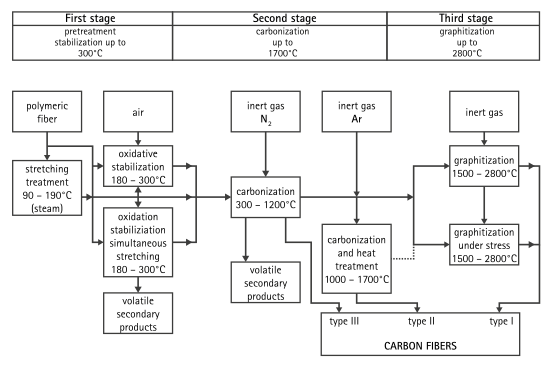
The process for making carbon fibres is a combination of partly chemical and partly mechanical. The precursor is drawn into long strands, ribbon’s or fibres and then heated to a very high temperature under enclosed conditions without allowing it to come in contact with oxygen.
Without oxygen, the fibre cannot burn. Instead, the high temperature causes the atoms in the fibre to vibrate violently until most of the non-carbon atoms are expelled. This process is called carbonization and leaves a fibre composed of long, tightly interlocked chains of carbon atoms with only a few non-carbon atoms remaining.
While ZOLTEK – carbon fibre manufacturing company has its own trade secrets and we’re also eager to encourage a broader understanding of carbon fibre as an ideal material for commercial use.

Stabilizing

Before the fibres are carbonized, they need to be chemically altered to convert their linear atomic bonding to a more thermally stable ladder bonding. This is accomplished by heating the fibres in air to about 390-590° F (200-300° C) for 30-120 minutes. This causes the fibres to pick up oxygen molecules from the air and rearrange their atomic bonding pattern. The stabilizing chemical reactions are complex and involve several steps, some of which occur simultaneously. They also generate their own heat, which must be controlled to avoid overheating the fibres.

Commercially, the stabilization process uses a variety of equipment and techniques. In some processes, the fibres are drawn through a series of heated chambers. In others, the fibres pass over hot rollers and through beds of loose materials held in suspension by a flow of hot air. Some processes use heated air mixed with certain gases that chemically accelerate the stabilization.

Carbonizing

Once the fibres are stabilized, they are heated to a temperature of about 1,830-5,500° F (1,000-3,000° C) for several minutes in a furnace filled with a gas mixture that does not contain oxygen. The lack of oxygen prevents the fibres from burning in the very high temperatures.
The gas pressure inside the furnace is kept higher than the outside air pressure and the points where the fibres enter and exit the furnace are sealed to keep oxygen from entering. As the fibres are heated, they begin to lose their non-carbon atoms, plus a few carbon atoms, in the form of various gases including water vapour, ammonia, carbon monoxide, carbon dioxide, hydrogen, nitrogen, and others.
As the non-carbon atoms are expelled, the remaining carbon atoms form tightly bonded carbon crystals that are aligned more or less parallel to the long axis of the fibre. In some processes, two furnaces operating at two different temperatures are used to better control the rate of heating during carbonization.

Treatment of the surface

After carbonizing, the fibres have a surface that does not bond well with the epoxies and other materials used in composite materials. To give the fibres better bonding properties, their surface is slightly oxidized. The addition of oxygen atoms to the surface provides better chemical bonding properties and also etches and roughens the surface for better mechanical bonding properties.
Oxidation can be achieved by immersing the fibres in various gases such as air, carbon dioxide, or ozone; or in various liquids such as sodium hypochlorite or nitric acid. The fibres can also be coated through electrolysis process where fibres are making the positive terminal in a bath filled with various electrically conductive materials.
The surface treatment process must be carefully controlled to avoid forming tiny surface defects, such as pits, which could cause fibre failure.

Sizing

After the surface treatment, the fibres are coated to protect them from damage during winding or weaving. This process is called sizing. Coating materials are chosen to be compatible with the adhesive used to form composite materials. Typical coating materials include epoxy, polyester, nylon, urethane, and others.
The coated fibres are wound onto cylinders called bobbins. The bobbins are loaded into a spinning machine and the fibres are twisted into yarns of various sizes.

Physical/chemical/mechanical properties of carbon fibres

  • Tenacity—1.8 —2.4 (kn/mm2)
  • Density—-1.95 gms/c.c
  • Elongation at break—-0.5%
  • Elasticity —not good
  • Moisture regain (M. R%)—-0%
  • Resilience—–Not good
  • Ability to protest friction—-Good
  • Colour—-Black
  • Ability to protest heat—–Good
  • Lustre—–Like silky
  • Carbon is a poor conductor of electricity because it is a nonmetal, which in general are poor conductors of electricity.
  • Carbon Fiber has High specific Strength to Weight Ratio
  • Carbon Fiber is very Rigid
  • Carbon fibre is Corrosion Resistant and Chemically Stable.
  • Carbon fibre is Electrically Conductive
  • Fatigue Resistance is good
  • Carbon Fiber has good Tensile Strength
  • Carbon fibre is Fire Resistance/Non-Flammable
  • Thermal Conductivity of Carbon Fiber–it is not possible to pinpoint exactly the thermal conductivity. Special types of Carbon Fiber have been specifically designed for high or low thermal conductivity.
  • Low Coefficient of Thermal Expansion–Carbon fibre can have a broad range and can be designed as per final requirement.
  • Non-Poisonous, Biologically Inert, X-Ray Permeable–These qualities make Carbon fibre useful in Medical applications
  • Carbon Fibers are brittle—The layers in the fibres are formed by strong covalent bonds.

Carbon Fiber is not yet geared to Amateur techniques.

In order to maximize Carbon Fiber Characteristics, a relatively high level of technical excellence must be achieved. Imperfections and air bubbles can significantly affect performance. Typically, autoclaves or vacuum equipment is required. Moulds and mandrels are major expenses as well.
The success of any amateur carbon fibre construction will be closely linked to the skill and care taken.

Chemical properties

  1. Effect of bleaching—-sodium hypochlorite slightly oxidized carbon fibres
  2. Effect of sunlight—-Do not change carbon fibres
  3. Protection against flame—–Excellent
  4. Protection ability against insects——Do not harm carbon fibres.

Carbon fibres are available in different forms

  1. Towscarbon-fiber-tows

    This tow gives a measure of its number of filaments per bundle. Small Tow has 24000 or fewer filaments, Large tow has 48000 to 320000 filaments and sometimes more. Normally is sold in large spools.
    Often Carbon tow is used in winding tubes and other structures, selectively reinforcing structures and used in compression moulding. It can be used in chop guns but fibreglass can usually be substituted effectively.
  2. Tapes

    Carbon fibre tape is available in 2″ wide 15feet long. Carbon tapes are used for reinforcement of carbon parts. It is easier to buy in this form than to cut your own stripes.
  3. Roving’s

    Carbon fibre is offered as bundled fibres. These are not woven but rather are bunches of unidirectional filaments. The terms Tow, Roving and Strand is more a measure of how large the bundle of fibre is than of actual differences in the form.
  4. Woven cloth

    carbon-fiber-plain-weave
    plain weave
    carbon-fiber-twill-weave
    twill weave
    Cloth comes in many weights and wide ranges are available. Home builders usually deal with 3.5-12 ounces per square yard. but other weights are possible.
    There are many types of weave. Most home builders are familiar with the plain weave. It is the easiest of weaves to wet out.
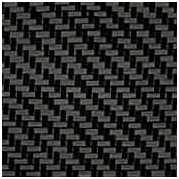
    Twill weaves (right) are also available. Twill weave usually has the fibres spanning 2 fibres. It makes it easier to form to a shape. Twill weave is reputed to be slightly stronger than plain weave. It is certainly very showy.
    Because the fibres bend up and down as they follow the weave there is a slight decrease in strength when compared with the uniaxial cloth that is made so that all the fibres run one way (except for the few that keep the cloth together.)
  5. Matting or Felt

    It is possible to find felted Carbon fibre but its use is not for reinforcement of matrix. IT has used in heat protection and safety applications. Home builders looking for a matted material normally use fibreglass.
  6. Carbon Fiber Veil

    Used in making corrosion resistant barriers and for grounding composite structures and minimizing static electricity build-up. The nonwoven structure allows a resin-rich surface that increases chemical stability and reduces micro-crack formation in the composite surface.
  7. Carbon fibre sleeves or socks

    carbon-fiber-tubes
    Carbon fibre tubes
    carbon-fiber-plain-mast
    Carbon fibre plain mast
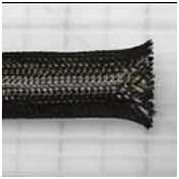
    These are available in 2 forms, either biaxially woven or unidirectional, with minimal stitching to keep the tube together until impregnated. These are very useful if making tubes or round pipes or masts. In the woven tubes, the fibres end up running diagonally along the tube. Woven tubes are very adjustable and can be used for several sizes simply by compressing lengthwise or stretching. This allows for tapered construction or for curves.
    Unidirectional tubing has the fibres running lengthwise only. This allows the composite to be reinforced in the longitudinal direction. Uniaxial tubes need to be bought in the right size since there is no stretch.
    Using these tubes simplifies making pipes, tubes and dinghy masts but they are quite expensive.
  8. Coatings and surface treatment

    In order to improve adhesion to the resin matrix, Carbon Fiber is sometimes surface treated. By partially oxidizing the fibre to make it more chemically active. Other coatings or treatments exist to modify the fibre’s handling such as polymer coatings.
  9. Hybrid or Combinations

    Carbon Fibre is sometimes combined with other fibres to modify its characteristics or to reduce cost.
    One of the most common combinations is with Kevlar. Since Kevlar can be dyed, several companies now offer coloured carbon fibre – Kevlar fabrics.
    When combining carbon fibre with metal it is good to remember that it is electrically conductive and can be involved in galvanic corrosion. The so-called Silver Carbon Fiber is actually aluminium and fibreglass.

Applications of Carbon Fiber Overview:

Reference – Todd Johnson, Updated March 30, 2017
Every day, a new application is found for carbon fibre. What started out forty years ago as a highly exotic material is now a part of our everyday lives. These thin filaments, a tenth of the thickness of a human hair, are now available in a wide range of useful forms. The fibres are bundled, woven and shaped into tubes and sheets (up to ½” thick) for construction purposes, supplied as cloth for moulding, or just regular thread for filament winding.
  1. Carbon Fiber in Flight

    Carbon fibre has gone to the moon on spacecraft, but it is also used widely in aircraft components and structures, where its superior strength to weight ratio far exceeds that of any metal. 30% of all carbon fibre is used in the aerospace industry. From helicopters to gliders, fighter jets to microlights, carbon fibre is playing its part, increasing range and simplifying maintenance.
  2. Sporting Goods

    Its application in sports goods ranges from the stiffening of running shoes to ice hockey stick, tennis racquets, and golf clubs. ‘Shells’ (hulls for rowing) are built from it, and many lives have been saved on motor racing circuits by its strength and damage tolerance in body structures. It is used in crash helmets too, for rock climbers, horse riders, and motorcyclists – in fact in any sport where there is a danger of head injury.
  3. Military

    The applications in the military are very wide ranging – from planes and missiles to protective helmets, providing strengthening and weight reduction across all military equipment.
    It takes energy to move weight – whether it is a soldier’s personal gear or a field hospital, and weight saved means more weight moved per gallon of gas.
    A new military application is announced almost every day. Perhaps the latest and most exotic military application is for small flapping wings on miniaturized flying drones, used for surveillance missions.
  4. Carbon Fiber at Home

    Areas as broad as your imagination, whether it is style or practical application. For those who are style-conscious, it is often tagged as ‘the new black’. If you want a shiny black bathtub built from carbon fibre or a coffee table then you can have just that, off the shelf. iPhone cases, pens, and even bow ties – the look of carbon fibre is unique and sexy.
  5. Medical Applications

    Carbon fibre offers several advantages over other materials in the medical field, including the fact that it is ‘radiolucent’ shows as black on X-ray images. It is used widely in imaging equipment structures to support limbs being X-rayed or treated with radiation.
    The use of carbon fibre to strengthen damaged cruciate ligaments in the knee is being researched, but probably the most well-known medical use is that of prosthetics – artificial limbs. South African athlete Oscar Pistorius brought carbon fibre limbs to prominence when the International Association of Athletics Federations failed to ban him from competing in the Beijing Olympics.
    His controversial carbon fibre right leg was said to give him an unfair advantage, and there is still considerable debate about this.
  6. Automobile Industry

    As costs come down, carbon fibre is being more widely adopted in automobiles. Supercar bodies are built now, but its wider use is likely to be on internal components such as instrument housings and seat frames.
  7. Environmental Applications

    As a chemical purifier, carbon is a powerful absorbent. When it comes to absorption of noxious or unpleasant chemicals, then surface area is important. For a given weight of carbon, thin filaments have far more surface area than granules. Although we see activated carbon granules used as pet litter and for water purification, the potential for wider environmental use is clear.