Search This Blog

Showing posts with label carded. Show all posts

Wednesday, 12 June 2019

What is GSM?

GSM is the short form for grams per square meter. All fabrics including towels have a measurement in weight, and the standard measurement is measured in grams per square meters. This number refers to the density of the towel. High-quality Turkish cotton towels are generally heavier and are more absorbent.

Towels can vary anywhere between 300 GSM and 900 GSM. The lower the number, the lighter and thinner the towel. For instance:
300-400 GSM – In this weight category the towels are lighter and thinner. Depending on its use, a lower GSM for the towels are manufactured for gym towel or a kitchen towel. A lightweight, shared beach towel might be around 350 GSM. Medium weight is 400-600 GSM. This weight is great for beach towels, bath towels, guest towels and so forth. Each consecutive gram weight –400, 500, 600– gets a little heavier, and a little more absorbent.
600-900 GSM – This is a premium, luxury weight. The towel will be denser, heavier, more absorbent. It will probably take a little longer to dry.

TERRY TOWELS – MEANS YOUR BATH COMPLETED

A terry towel is a textile product which is made with pile loops on one or both sides covering the entire ground surface or forming pile strips, pile checks, or other pile patterns (with hemming end or with firm selvages).

https://www.shutterstock.com/image-photo/six-pieces-white-cotton-towel-set-1304872951

A terry towel is a textile product which is made with pile loops on one or both sides covering the entire ground surface or forming pile strips, pile checks, or other pile patterns (with hemming end or with firm selvages). Turkish Toweling fabrics structures form a class of warp pile termed terry pile in which certain warp threads form loops or curls on the face of the cloth.  We may use one weft and two series of warp threads placed on two warp beams are necessary for the production of this cloth.
Cashmere Towels are made of Superior Ring Spun Quality Yarn. They are soft and luxurious and will provide a sense of comfort to your valued guests.  Cashmere Towels are the best choice you will make by balancing luxury and cost.

History of Terry Weaving

The invention of the towel is commonly associated with the city of Basra, Turkey in the 17th century. These Turkish towels began as a flat, woven piece of cotton or linen called a postal, often hand-embroidered. The name word terry came from French word tire which referred to pile loops which were initially pulled by hand Long enough to make it absorbent cloth and wrap around the body. These postal manufactured were originally fairly narrow, but now are wider and commonly measure 90 by 170 centimeters (35 in × 67 in). Pestamel were used in Turkish baths as they stayed light when wet and were very absorbent.

Fibre Raw materials used for terry towels

  1. Cotton
  2. Bamboo
  3. Model
  4. Lyocell
  5. Flax
  6. Synthetics microfibers (polyester, nylon)
  7. Cashmere

Yarns used for towels


Both open end and ring spun yarns can be used depending on designing parameters of terry towels. Normally three yarn components are used in manufacturing terry towels. Normal twisted yarn with normal twist factor for ground yarn, low twisted yarn with lower twist factor for pile yarn and low twist or normal twisted yarn for weft yarns.
Single or double yarns are used for all or few yarn components again depending on how the product has been designed. To make towels more absorbent and soft, twist less cotton ring spun yarns are also used.
For producing twistless yarn, cotton ring spun yarn with very low twist factor is covered with a water-soluble PVA filament yarn on yarn covering machine or is twisted on TFO machine the direction of double yarn twist is opposite to that of the single spun yarn twist, and the amount of twist factor is adjusted to normal twist required in the spun yarn. By this process, the PVA filament wrapped around the cotton yarn and the yarn was sufficiently strong due to the cohesion has given by the filament which makes it weave able and during finishing operations, the PVA yarn is dissolved in water.

Classification of Terry Towels

The classification of towels can be made according to construction, dimensions, pile presence on fabric front and back surfaces, pile height formation, pile structure, finishing and weight per square meter.

Construction of Terry Towels

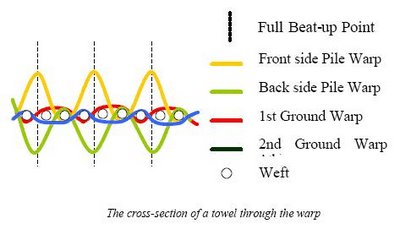
Terry towels are woven as 2, 3, 4, 5 or more pick terry weaves. The most common type is 3-pick terry toweling. The cross-section of a toweling through the Warps are divided into two systems as shown in Figure 3, pile warps and ground warps, whereas wefts consist of only one system. In basic Turkish Toweling, front side and back side pile warps and 1st and 2nd ground warp end form a 2/1 rib weave with each other.
The rib weaves which is formed by the pile warps is one pick ahead of the rib weave which is formed by ground warp ends. Warps are drafted throughout the fabric width 1:1 or 2:2 piles and ground warps. In 1:1 warp drafting order each ground warp end is followed by a pile warp end while in 2:2 warp drafting order each two ground warp ends are followed by two pile warp ends. In Figures 3a and 3b, the weave notation of 3 weft pile basic Turkish toweling is given in 1:1 and 2:2 warp orders.
cross-section-of-terry-tewel-through-the-warp
As is seen from the weave diagrams in Figures a and b, the shedding of the ground warps is not synchronized with that of the pile warps. By this, the number of interlacing throughout the warp increases, and this strengthens the fabric. As it has been mentioned before terry towels can have pile loops on one or both faces. Different types of terry weave which have piled on one face and both faces.

Basic 3-pickup terry weave in 1:1 Warp Order
Basic 3-pickup terry weave in 2:2 Warp Order
G: Ground Warp
FP: Front Face Pile Warp
BP: Back Face Pile Warp
Little block: Ground warp is over the weft
Shaded: Front Face Pile Warp is raised over the weft
X: Back Face Pile Warp is raised over the weft
Empty space: Warp is lowered behind the weft
The picks used for toweling is between 15 and 25 picks/cm. And ends used are between 20 and 30 ends/cm. During the weaving of borders, the picks are increased 3 to 6 times the density in the pile areas Pile/ground ratio is described as the length of pile warp per unit length of fabric in the warp direction.
A practical way to find out this ratio is done by measuring a 10 cm length of toweling in the warp direction, then cut the pile warp from either end of the measured length and measure the total length of the removed pile end per 10 cm length of fabric. Pile warp length per 10 cm fabric is usually between 20-100 cm. This ratio has a direct effect on fabric weight and thickness. As the ratio increases, the weight and the thickness of the terry fabric increases.

The manufacturing process of Terry Towels

Spinning

This is the process where selected fibers are converted to yarns of desired counts needed for towels. Some integrated textile towelling mills produce their own yarns for towels. They purchase bales of cotton of a specific grade as per their working plan.
  • Mixing of fibers are formulated as per the required plan and are subjected to required atmospheric conditions before they are passed through the blow room line. Here strictly mill mixing plan is being followed. According to the mix plan selection of machines to process and their machine settings are made before mixing is allowed to pass through the blow room line.
  • Once planned results in the blow room process are accomplished then these fibers are passed directly through chute feeding to well-set carding machines and fibers are converted into slivers.
  • These carding slivers are tested for various technological parameters before they are passed to next process Drawing frames. These draw frames are set as per working plan and slivers are passed through for effective blending and parallelization of fibers. Draw frame slivers are tested for parameters and if passed they are further processed. Draw frame slivers may be semi-combed then again passed through draw frames before they are fed to roving frames (Speed frame).
  • Slivers are converted to rovings of specified hank as per spinning plan. Thereafter these roving bobbins are fed to ring frames well set with technological parameters as per spinning plan where they are converted to particular yarn counts to be used for terry towels.
  • These ring bobbins are fed to automatic winding machines where the yarn is converted to packages. These winding machines are also ser for different setting required as per spinning plan.
  • Whenever double yarns are needed for weaving terry towels the single yarns are processed on TFO machines to convert them to double yarns with defined twist factor and direction of the twist as required for towels.
Preparation of spinning plan is very critical and needs a lot of knowledge and understanding of spinning technology. Application of this spinning plan determines yarn parameters and yarn quality and hence needs close supervision from process control and quality control laboratory.
Comprehensive Weaving manufacturing plan is prepared as per terry towel set and construction.

Warping/Sizing/Drawing-in

Yarn packages are assembled on warping creel as per construction plan, required tensions are set on each yarn package and are processed on sectional or direct warping machines depending on single/double yarns are used.
All machine settings, machine speed is set as per instruction sheets of weaving plan. All warping sets made from single yarns are processed on sizing machines where a starch coating is applied on individual threads to make it weave able on weaving machines. Double yarns sets may or may not be passed through sizing machines. Single sized beams and double sized or unsized beams are taken to drawing in department and beams are drawn as per drawing in weaving plan to make them ready to load on weaving machines.
Loading of beams is high skill jobs which are to be carried out under the close supervision of weaving staff. Before machines are loaded on weaving machines, machines are to be well set, speeds adjusted as per an article by experienced, skilled and qualified weaving staff. Use of machine setting sheets as per weaving set plan is essential and important before the machine is set for production. Process control staff and weaving senior staff has to monitor the initial production of few towels and inspect on the machine and off the machine the various parameters of the towel and should exactly match as per weaving plan. Once passed the machine is allowed to go into production.
Mechanism of terry weave in terry fabric manufacturing, two sheets of warp threads run simultaneously, of which, one is kept under normal tension and other is kept under loose tension. The threads of normal tension warp sheet are for ground and threads of loose tension warp sheet are for the pile.

The sequence of operations during weaving for pile formation in 3-pick terry is given below:

  • Insertion of the first pick as per the design with loose beating
  • Allow a predetermined gap near the feel of cloth
  • Insertion of the second pick following the first pick with loose beating
  • Insertion of the third pick with heavy beating and bring all the three picks to the fell of the cloth.

Pile formation

Pile of the towel plays a major role for a towel for its water absorbency and other properties. Loop length is decided by the quality, weight, etc. as per requirements. Pile manufacturers use better quality yarn like combed, compact, hydro, zero twisted yarns.

Piles are made by different high-value fibers like superior qualities of cotton suvin, Giza, Pima, bamboo, modal etc. to get better absorbency and lint properties.
For ground yarn, comparatively coarser counts are used in OE and 2-ply option to give better strength and compactness in ground fabric.
Both piles and ground yarns are prepared in the same manner of warping, sizing, and drawing-in.  Like other textile products shirting, suiting, sheeting fabrics, towel making has the same process sequences – desizing, bleaching, dyeing and finishing.

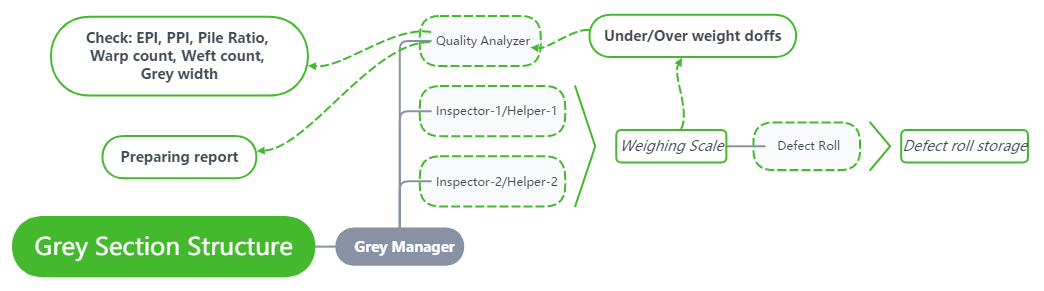
Grey inspection

Grey Section Structure
Once towels are manufactured on the looms and their production is monitored through process control the towel roles are cut as per specification sheet and brought to inspection room.
From inspection room storage selected quality rolls passed for quality as per processing plan are dispatched to process house for bleaching and dying operations.

Bleaching

These selected rolls are transported by using recommended trolleys to bleaching section and are bleached in J-Box machine which is a continuous bleaching machine. The fabric is treated with bleaching recipes such as hydrogen peroxide, caustic defoamers and other ingredients.
Reaction time and machine speed have to be set as per process plan prepared after considering all activity factors. After the roll is bleached it is sent to washing machines and washed thoroughly so that no trace of chemicals remains on the fabric. Then these rolls are dried and sent to Dyehouse. All procedural requirements are followed so that the rolls can be identified at any stage during processing and in storage.

Dyeing

As per requirement order from dye house, bleached rolls are transported to dye house for dying operations for various colours as per dye house planning sheets. Dried uncut rolls are taken to Dying machines for dying with vat color using vat dye receipt. This has proven over time to provide colorfast toweling after extensive residential laundering.
It is sent to washing machines and washed thoroughly so that no trace of chemicals and lose dye particles remain on the fabric. Then these rolls are dried on an air-drying machine and sent to folding cutting/folding and packaging department. All procedural requirements are followed so that the rolls can be identified at any stage to avoid mix-ups during processing and in final storage.

Cutting, folding, and packaging

As per final inspection plan, rolls are transported with special care to finish folding department.
Instruction techniques to follow are for visual inspection
  • Step 1: is to open these rolls and are cut as per instruction sheets
  • Step 2: is to stitch / ham towels
  • Step3: Each towel stitched is inspected by a quality inspector attached to a respective table. He has to ensure defect free towel on both sides, the label for passing and sent to final inspection table. The rejected towels are to be kept separately for operational departmental inspection
  • Step 4: Final inspection by a senior inspector passed, labeled and sent for final packaging and dispatching. Rejected towels are kept separately.

Quality Control

Quality assurance department plays an important role to monitor, check, and control each manufacturing activities and operations from receiving all raw material to the final dispatch of products. This is controlled through close supervision and active participation of on-line process control and off-line quality control laboratory. Most common defects found in terry towels are…
Objectional odors, Holes (two or more broken ends), abrasion mark, Bow, Skew, crease, oil stains, dye stains, miss pick, double picks, sharp press mark, fiber contamination, dye/bleach shade variations.
All Towels manufacturing mills need to have a strong quality assurance department which is capable to coordinate with production line and assist them to provide vital quality productivity information continuously.
All incoming inputs bought for the manufacturing process are thoroughly examined for their quality parameters as laid down by production plan before they are used during manufacturing operations.

Caring for your Towels

  • Wash towels at between 40-60°C
  • Wash with similar colours or use a colour catcher
  • Tumble dry towels to keep them soft and fluffy
  • Use fabric conditioners sparingly and not in every wash as they decrease absorbency
  • Wash separately from garments with zips or trims to avoid snagging
  • Shake towels before washing –this opens up the fibres slightly to allow the detergent to sink inside.

Key points to focus during production planning

  1. Customers support. Fully understanding customers requirements and their expectations.
  2. Process control providing products utilizing proven designs and manufacturing process.
  3. Top employees developing a highly trained workforce that is skilled, motivated, understandable, empowered and fully accountable.
  4. Robust supply chain: establishing strong relationships with world-class suppliers
  5. continuous improvement: continually improve the efficiency of the business processes and operational activities and operations, quality management systems.

Calculations for terry towels to find the weight of ground warp, pile warp and weft yarn

Assumptions

  • Number of Ground Warp Ends = 694
  • Ground Warp Count = 25 tex x 2
  • Warp Crimp = 8%
  • Weft Yarn count = 34 tex
  • Number of Pile Warp Ends = 576
  • Length of pile part = 102 cm
  • Pile Ratio (for pile height)= 52:10 (52 cm of pile warp for 10 cm of cloth)
  • Pile Yarn count = 30 tex x 2
  • Length of plain part = 4 cm
  • Picks per cm = 20
  • Reed Width = 58.4 cm
  • Grey Length ( Pile and Plain Part) = 106 cm
  • Fringe Length = 2 cm

Friday, 14 December 2018

What are textiles?


A textile is a flexible material consisting of a network of natural or artificial fibers (yarn or thread). Yarn is produced by spinning raw fibers of wool, flax, cotton, hemp, or other materials to produce long strands. Textiles are formed by weaving, knitting, crocheting, knotting, felting, or braiding.

The related words "fabric" and "cloth"are often used in textile assembly trades (such as tailoring and dressmaking) as synonyms for textile. However, there are subtle differences in these terms in specialized usage. A textile is any material made of interlacing fibers, including carpeting and geo textiles. A fabric is a material made through weaving, knitting, spreading, crocheting, or bonding that may be used in production of further goods (garments, etc.). Cloth may be used synonymously with fabric but is often a piece of fabric that has been processed

History
The first clothes, worn at least 70,000 years ago and perhaps much earlier, were probably made of animal skins and helped protect early humans from the ice ages. Then at some point people learned to weave plant fibers into textiles.

The discovery of dyed flax fibres in a cave in the Republic of Georgia dated to 34,000 BCE suggests textile-like materials were made even in prehistoric times.


The production of textiles is a craft whose speed and scale of production has been altered almost beyond recognition by industrialization and the introduction of modern manufacturing techniques. However, for the main types of textiles,

plain weave, twill, or satin weave, there is little difference between the ancient and modern methods.


Uses
Textiles have an assortment of uses, the most common of which are for clothing and for containers such as bags and baskets. In the household they are used in carpeting, upholstered furnishings, window shades, towels, coverings for tables, beds, and other flat surfaces, and in art. In the workplace they are used in industrial and scientific processes such as filtering. Miscellaneous uses include flags, backpacks, tents, nets, handkerchiefs, cleaning rags, transportation devices such as balloons, kites, sails, and parachutes; textiles are also used to provide strengthening in composite materials such as fibreglass and industrial geotextiles. Textiles are used in many traditional crafts such as sewing, quilting and embroidery. Textiles for industrial purposes, and chosen for characteristics other than their appearance, are commonly referred to as technical textiles. Technical textiles include textile structures for automotive applications, medical textiles (e.g. implants), geotextiles (reinforcement of embankments), agrotextiles (textiles for crop protection), protective clothing (e.g. against heat and radiation for fire fighter clothing, against molten metals for welders, stab protection, and bullet proof vests). In all these applications stringent performance requirements must be met. Woven of threads coated with zinc oxide nanowires, laboratory fabric has been shown capable of "self-powering nanosystems" using vibrations created by everyday actions like wind or body movements.

Sources and types

Textiles are made from many materials, with four main sources: animal (wool, silk), plant (cotton, flax, jute), mineral (asbestos, glass fibre), and synthetic (nylon, polyester, acrylic). The first three are natural. In the 20th century, they were supplemented by artificial fibres made from petroleum.
Textiles are made in various strengths and degrees of durability, from the finest microfibre made of strands thinner than one denier to the sturdiest canvas. Textile manufacturing terminology has a wealth of descriptive terms, from light gauze-like gossamer to heavy grosgrain cloth and beyond.

Animal

Animal textiles are commonly made from hair, fur, skin or silk (in the silkworms case).
Wool refers to the hair of the domestic goat or sheep, which is distinguished from other types of animal hair in that the individual strands are coated with scales and tightly crimped, and the wool as a whole is coated with a wax mixture known as lanolin (sometimes called wool grease), which is waterproof and dirtproof.Woollen refers to a bulkier yarn produced from carded, non-parallel fibre, while worsted refers to a finer yarn spun from longer fibres which have been combed to be parallel. Wool is commonly used for warm clothing. Cashmere, the hair of the Indian cashmere goat, and mohair, the hair of the North African angora goat, are types of wool known for their softness.
Other animal textiles which are made from hair or fur are alpaca wool, vicuña wool, llama wool, and camel hair, generally used in the production of coats, jackets, ponchos, blankets, and other warm coverings. Angora refers to the long, thick, soft hair of the angora rabbit. Qiviut is the fine inner wool of the muskox.
Wadmal is a coarse cloth made of wool, produced in Scandinavia, mostly 1000~1500 CE.
Sea silk is an extremely fine, rare, and valuable fabric that is made from the silky filaments or byssus secreted by a gland in the foot of pen shells.
Silk is an animal textile made from the fibres of the cocoon of the Chinese silkworm which is spun into a smooth fabric prized for its softness. There are two main types of the silk: 'mulberry silk' produced by the Bombyx Mori, and 'wild silk' such as Tussah silk. Silkworm larvae produce the first type if cultivated in habitats with fresh mulberry leaves for consumption, while Tussah silk is produced by silkworms feeding purely on oak leaves. Around four-fifths of the world's silk production consists of cultivated silk.

Plant

Grass, rush, hemp, and sisal are all used in making rope. In the first two, the entire plant is used for this purpose, while in the last two, only fibres from the plant are utilized. Coir (coconut fibre) is used in making twine, and also in floormats, doormats, brushes, mattresses, floor tiles, and sacking.
Straw and bamboo are both used to make hats. Straw, a dried form of grass, is also used for stuffing, as is kapok.
Fibres from pulpwood trees, cotton, rice, hemp, and nettle are used in making paper.
Cotton, flax, jute, hemp, modal and even bamboo fibre are all used in clothing. Piña (pineapple fibre) and ramie are also fibres used in clothing, generally with a blend of other fibres such as cotton. Nettles have also been used to make a fibre and fabric very similar to hemp or flax. The use of milkweed stalk fibre has also been reported, but it tends to be somewhat weaker than other fibres like hemp or flax.
The inner bark of the lacebark tree is a fine netting that has been used to make clothing and accessories as well as utilitarian articles such as rope.
Acetate is used to increase the shininess of certain fabrics such as silks, velvets, and taffetas.
Seaweed is used in the production of textiles: a water-soluble fibre known as alginate is produced and is used as a holding fibre; when the cloth is finished, the alginate is dissolved, leaving an open area.
Lyocell is a synthetic fabric derived from wood pulp. It is often described as a synthetic silk equivalent; it is a tough fabric that is often blended with other fabrics – cotton, for example.
Fibres from the stalks of plants, such as hemp, flax, and nettles, are also known as 'bast' fibres.

Mineral

Asbestos and basalt fibre are used for vinyl tiles, sheeting and adhesives, "transite" panels and siding, acoustical ceilings, stage curtains, and fire blankets.
Glass fibre is used in the production of ironing board and mattress covers, ropes and cables, reinforcement fibre for composite materials, insect netting, flame-retardant and protective fabric, soundproof, fireproof, and insulating fibres. Glass fibres are woven and coated with Teflon to produce beta cloth, a virtually fireproof fabric which replaced nylon in the outer layer of United States space suits since 1968.
Metal fibre, metal foil, and metal wire have a variety of uses, including the production of cloth-of-gold and jewellery. Hardware cloth (US term only) is a coarse woven mesh of steel wire, used in construction. It is much like standard window screening, but heavier and with a more open weave.
Minerals and natural and synthetic fabrics may be combined, as in emery cloth, a layer of emery abrasive glued to a cloth backing. Also, "sand cloth" is a U.S. term for fine wire mesh with abrasive glued to it, employed like emery cloth or coarse sandpaper.

Synthetic

Synthetic textiles are used primarily in the production of clothing, as well as the manufacture of geotextiles.
Polyester fibre is used in all types of clothing, either alone or blended with fibres such as cotton.
Aramid fibre (e.g. Twaron) is used for flame-retardant clothing, cut-protection, and armour.
Acrylic is a fibre used to imitate wools, including cashmere, and is often used in replacement of them.
Nylon is a fibre used to imitate silk; it is used in the production of pantyhose. Thicker nylon fibres are used in rope and outdoor clothing.
Spandex (trade name Lycra) is a polyurethane product that can be made tight-fitting without impeding movement. It is used to make activewear, bras, and swimsuits.
Olefin fibre is a fibre used in activewear, linings, and warm clothing. Olefins are hydrophobic, allowing them to dry quickly. A sintered felt of olefin fibres is sold under the trade name Tyvek.
Ingeo is a polylactide fibre blended with other fibres such as cotton and used in clothing. It is more hydrophilic than most other synthetics, allowing it to wick away perspiration.
Lurex is a metallic fibre used in clothing embellishment.
Milk proteins have also been used to create synthetic fabric. Milk or casein fibre cloth was developed during World War I in Germany, and further developed in Italy and America during the 1930s.Milk fibre fabric is not very durable and wrinkles easily, but has a pH similar to human skin and possesses anti-bacterial properties. It is marketed as a biodegradable, renewable synthetic fibre.
Carbon fibre is mostly used in composite materials, together with resin, such as carbon fibre reinforced plastic. The fibres are made from polymer fibres through carbonization.

Production methods

Top five exporters of textiles—2013
($ billion)
China 274
India 40
Italy 36
Germany 35
Bangladesh 28
Weaving is a textile production method which involves interlacing a set of longer threads (called the warp) with a set of crossing threads (called the weft). This is done on a frame or machine known as a loom, of which there are a number of types. Some weaving is still done by hand, but the vast majority is mechanized.
Knitting, looping, and crocheting involve interlacing loops of yarn, which are formed either on a knitting needle, needle, or on a crochet hook, together in a line. The processes are different in that knitting has several active loops at one time, on the knitting needle waiting to interlock with another loop, while Looping and crocheting never have more than one active loop on the needle. Knitting can be performed by machine, but crochet can only be performed by hand.
Spread Tow is a production method where the yarn are spread into thin tapes, and then the tapes are woven as warp and weft. This method is mostly used for composite materials; spread tow fabrics can be made in carbon, aramide, etc.
Braiding or plaiting involves twisting threads together into cloth. Knotting involves tying threads together and is used in making macrame.
Lace is made by interlocking threads together independently, using a backing and any of the methods described above, to create a fine fabric with open holes in the work. Lace can be made by either hand or machine.
Carpets, rugs, velvet, velour, and velveteen are made by interlacing a secondary yarn through woven cloth, creating a tufted layer known as a nap or pile.
Felting involves pressing a mat of fibres together, and working them together until they become tangled. A liquid, such as soapy water, is usually added to lubricate the fibres, and to open up the microscopic scales on strands of wool.
Nonwoven textiles are manufactured by the bonding of fibres to make fabric. Bonding may be thermal or mechanical, or adhesives can be used.
Bark cloth is made by pounding bark until it is soft and flat.

Treatments

Textiles are often dyed, with fabrics available in almost every colour. The dyeing process often requires several dozen gallons of water for each pound of clothing.Coloured designs in textiles can be created by weaving together fibres of different colours (tartan or Uzbek Ikat), adding coloured stitches to finished fabric (embroidery), creating patterns by resist dyeing methods, tying off areas of cloth and dyeing the rest (tie-dyeing), or drawing wax designs on cloth and dyeing in between them (batik), or using various printing processes on finished fabric. Woodblock printing, still used in India and elsewhere today, is the oldest of these dating back to at least 220 CE in China. Textiles are also sometimes bleached, making the textile pale or white.

Textiles are sometimes finished by chemical processes to change their characteristics. In the 19th century and early 20th century starching was commonly used to make clothing more resistant to stains and wrinkles.
Eisengarn, meaning "iron yarn" in English, is a light-reflecting, strong material invented in Germany in the 19th century. It is made by soaking cotton threads in a starch and paraffin wax solution. The threads are then stretched and polished by steel rollers and brushes. The end result of the process is a lustrous, tear-resistant yarn which is extremely hardwearing.
Since the 1990s, with advances in technologies such as permanent press process, finishing agents have been used to strengthen fabrics and make them wrinkle free. More recently, nanomaterials research has led to additional advancements, with companies such as Nano-Tex and NanoHorizons developing permanent treatments based on metallic nanoparticles for making textiles more resistant to things such as water, stains, wrinkles, and pathogens such as bacteria and fungi.
Textiles receive a range of treatments before they reach the end-user. From formaldehyde finishes (to improve crease-resistance) to biocidic finishes and from flame retardants to dyeing of many types of fabric, the possibilities are almost endless. However, many of these finishes may also have detrimental effects on the end user. A number of disperse, acid and reactive dyes (for example) have been shown to be allergenic to sensitive individuals. Further to this, specific dyes within this group have also been shown to induce purpuric contact dermatitis.
Although formaldehyde levels in clothing are unlikely to be at levels high enough to cause an allergic reaction, due to the presence of such a chemical, quality control and testing are of utmost importance. Flame retardants (mainly in the brominated form) are also of concern where the environment, and their potential toxicity, are concerned. Testing for these additives is possible at a number of commercial laboratories, it is also possible to have textiles tested for according to the Oeko-tex certification standard which contains limits levels for the use of certain chemicals in textiles products.


Friday, 23 November 2018

Textile Technologies

Textile technology is a program of study that can cover a broad range of topics, from chemistry and physics in textile production to textiles used in apparel and interior design. Keep reading to discover education and career options in this field.

Inside Textile Technologies

Textile technology programs teach the science of creating and enhancing fibers, fabrics and other textiles used in manufacturing, apparel, healthcare and consumer products. Training in textile technology prepares students for a number of different career paths, such as textile engineer, interior designer, materials scientist and researcher. If any of these occupations interest you, check out the article links from Study.com listed below.

Education Information

Courses in textile technology programs can include textile chemistry, physics, molecular studies, biomedical materials and material composition. Students learn how to create and test fibers from both natural and synthetic sources. Technology programs in textiles and materials can be found in engineering or textile colleges at the undergraduate and graduate degree and certificate level. Online and hybrid programs are also available, often at the master's degree level.

Thursday, 21 April 2016

Terry Towelling parameters for designing and production

Terry Towelling parameters for designing and production 

- Size of towel: Grey & Finish

- Dimentions of Hem, Terry Bar, Border and Body Of Towel

- Finish & Grey weight/GSM of towel

- Reed count ie warp density

- Weft density (Body & Border)

- No. of splits on loom

- Yarn used in warp(Pile & Ground),weft(Body Weft & Border Weft)

- Material used cotton /polyester(Pile, Ground & weft)

- Major count _2/20 k, 2/24 K, 1/10 OE, 1/14 OE, 1/16k etc.

- Tape length used in pile and ground

- Weight loss consideration during all process like shearing, washing,tumbling and dying etc.

- Production calculations by PCs and wt.

- Wastage parameter at various stage of manufacturing

- Pile Height

Friday, 7 August 2015

Terry Towel Calculations -1

Assumptions
Number of Ground Warp Ends = 694
Ground Warp Count = 25 tex x 2
Warp Crimp = 8%
Weft Yarn count = 34 tex
Number of Pile Warp Ends = 576
Length of pile part = 102 cm
Pile Ratio (for pile height)= 52:10 (52 cm of pile warp for 10 cm of cloth)
Pile Yarn count = 30 tex x 2
Length of plain part = 4 cm
Picks per cm = 20
Reed Width = 58.4 cm
Grey Length ( Pile and Plain Part) = 106 cm
Fringe Length = 2 cm

How to Determine the Weight of a ground Warp for Terry Towel

Weight of Ground Warp = Weight of ground warp in grey cloth + weight of ground warp in the fringe.

Weight of ground warp in grey cloth = (length of grey cloth x warp crimp factor x no of ground warp threads x warp yarn count in tex )/ (100 x 1000)
= (106 x 1.08 x 694 x 25 x 2)/(100 x 1000)
= 397.25 gms

Weight of Ground Warp in Fringe (here the warp crimp is not involved) = (Fringe length x no of ground warp x yarn count in tex)/ (100x 1000)
= (2 x 694 x 25 x 2)/ (100 x 1000) = 0.69 gms

So Ground Warp Weight = 397.25 +.69 = 397.94 grams.

How to Determine the Weight of Pile Warp in Terry Towel


Weight of Pile Warp = weight of pile warp in pile part + that in plain part + that in fringe

a. Weight of pile warp in pile part ( Pile ratio: 52:10)
=( Length of pile part x number of pile threads x pile length x yarn count in tex) / (100 x 1000)
= (102 x 576 x 52 x 30 x 2)/(100 x 1000)
= 183.31 g

b. Weight of Pile warp in Plain Part
=( Length of plain fabric x number of pile threads x crimp factor x yarn count)/ (100 x 1000)
= (4 x 576 x 1.08 x 30 x 2)/(100 x 1000)
= 1.49 g

c. Weight of Pile warp in fringe ( No crimp , no loop )
= (fringe length x number of pile threads x yarn count)/(100 x 1000)
= (2 x 576 x 30 x 2)/(100 x 1000)
= 0.69 g
Weight of pile warp = 183.31+ 1.49 + 0.69 = 185.49

How to Determine the Weight of Weft in Terry Towel

Weight of Weft Yarn

= (Total no of weft threads x reed width x yarn count)/(100 x 1000)
(Reed width is equal to the length of one weft yarn)
= (106 x 20 x 58.4 x 34)/(100 x 1000)
= 42.09 g