Introduction:
This article has been written for the beginners of garments & buying house. So, I’ve emphasized on very basic things. I’ve also tried to use easy English to make it understandable for all.
A. Weight Conversion:
As a garments / buying house worker, we often need converting weight. For this, we need know the information below.
1 lb. = 453.6 grams -----LBs = Grams / 453.6 -----Grams = LBs X 453.6
1 kg = 2.2 lbs. ----------Kilogram = LBs / 2.2 -----LBs = KG X 2.2
1. A sweater’s weight 950 grams, find out weight in lbs.?
Answer: 950 / 453.6 = 2.094 LBs (Pounds) (453.6 grams = 1 lb.)
2. A Bundle of Yarn’s weight 3 lbs., find out weight in grams?
Answer: 3 x 453.6 = 1360.80 grams (1 lb. = 453.6 grams)
3. A sweater of 3 kg weight, find out weight in lbs. ?
Answer: 3 x 2.2 = 6.6 lbs. (1kg = 2.2 lbs.)
4. A sweater of 3 lbs. weight, find out weight in KGs ?
Answer: 3 / 2.2 = 1.36 KGs (2.2 lbs. = 1 kg)
B. GSM, Oz, Embroidery Unit:
We, the workers of garments & buying house, are very much familiar to GSM, Oz & Embroidery. For novice, please note, it’s generally counted weight of knitted fabric in GSM (Grams per Square Meter). For woven fabrics, it’s counted weight in Oz (Ounce) Per Square Yard. Now we will learn how to convert them.
Oz per Square Yards = GSM / 33.906 ----12000 stitches = 1 unit (embroidery stitch)
100cm X 100cm X 100cm = 1 CBM -----12inches X 12inches X 12 inches = 1 Cubic Feet
5. A Single Jersey Knit Fabric GSM 200 grams, find out Oz Per Square Yard ?
Answer: 200 / 33.906 = 5.898 Oz. (33.906 GSM =1 Oz per Square Yard)
6. A Twill Fabric of 8 Oz, find out it’s GSM ?
Answer: 8 x 33.906 = 271 GSM. (1 Oz per Square Yards = 33.906 GSM)
7. A fabric with warp thread 120, weft thread 60, Count of yarn 40, find out its GSM ?
Answer: (120 + 60) x 47 / (40 +
40) + 5 = 110 GSM (We should called around 110 as there are a lot of
formulas & no formula can reach the actual amount of GSM till now)
Formula: ( warp + weft) x 47 / (warp count. + Weft Count.) + 5 = GSM.
In case different types of warp thread
or weft thread is used then this formula may not work accurately. It is
also known as conversion formula from Fabric Construction to Fabric
Weight.
8. A woven fabric with warp thread 120, weft thread 60, Count of yarn 40, find out its Oz per Square Yard?
Answer: {(120 + 60) x 47 / (40 + 40) + 5} / 33.906 = 3.27 Oz per Square Yard. (1 Oz per Square Yard = 33.906 GSM)
Formula: {(warp + weft) x 47 / (warp count + Weft Count) + 5} / 33.906 = Oz per Square Yard
See the photo below to identify warp & weft threads.
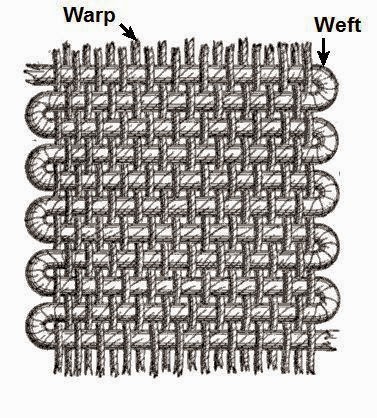 |
| Identify warp & weft threads |
Note: Fabric Construction (120 x 60 / 40 x 40) means there are 120 threads in warp (EPI) & 60 threads in weft (PPI) & both yarn’s count is 40 on 1 square inch fabric. EPI means Ends per Inch & PPI means Picks per Inch.
See photo below to identify EPI & PPI.
 |
| Identify EPI & PPI |
The image above shows that vertical threads are EPI (warp thread) & horizontal threads are PPI (weft thread).
9. A carton Length 60cm, Width 40cm & Height 30cm, find out CBM (Cubic Meter) ?
Answer: 60 x 40 x 30 / 1000000 = 0.072 CBM (1 CBM = 1000000 square cm)
Formula: length X width X height / 1000000
10. Carton’s Length 80cm, Width 60cm, Height 30cm, find out CBM of 100 cartons ?
Answer: 80 x 60 x 30 / 1000000 x 100 = 14.4 CBM.
Formula: length X width X height / 1000000 X carton quantity
11. Carton’s Length 14 inches, Width 12 inches, Height 8 inches, find out CBF (Cubic Feet)?
Answer: 14 x 12 x 8 / 1728 = 0.777 CBF (1 CBF = 1728 square inches)
Formula: length X width X height / 1728
12. 1 unit embroidery stitch price tk.20, one garment has 800 embroidery stitches, find out embroidery costing of the garment ?
Answer: 20 / 12000 x 800 = 1.33 taka. 1 embroidery unit = 12000 embroidery stitches.
Formula: price / 12000 X embroidery stitches
C. Measures Conversion:
To learn about Measures conversion, please memorize the formulas below. It’s so important for RMG workers to know & learn measures conversion.
1 inch = 2.54 cm centimeter (cm) = inch X 2.54 1 meter = 39.37 inches 36 inches = 1 yard
13. A fabric with a length of 100 yards, find out it’s length in meters ?
Answer: 100 x 36 / 39.37 = 91.44 Meters (1 yards = 36 inches) (1 meter = 39.37 inches)
14. A fabric with a length of 100 meters, find out it’s length in yards ?
Answer: 100 x 39.37 / 36 = 109.36 Yards.
15. A fabric’s Width (Dia) is 54 inches, find out the Knitting Machines Dia in cm ?
Answer: 54 x 2.54 + 1.62(Shrinkage Percentage) = 138.78cm
(Suppose, this fabric’s shrinkage% is 3 after finish/wash. We’ll learn of fabric shrinkage in my next Note well)
D. Fabric Consumption:
Fabric Consumption is very important for a probationer of management & merchandising. As 60% to 70% cost of a garments comes from fabrics. During fabric consumption, please consider wastage minimum 5%.
16. A fabric piece of Length 10 yards, Width 40 inches & GSM 180, find out its weight in kg?
Answer: 10 x 36 x 40 x 180 / 1550000 = 1.67 KGs
Formula: length X width X GSM / 1550000 (1 yard = 36 inches)
Firstly, you have to convert the fabric
length into inches, as you see we have fabric length in yard & width
is in inches. Please note, divided value “1550000” is used if the
measures of fabric is mentioned in inches or yards. For cm & meters,
the value will be changed.
17. A fabric roll of Length 70 meters, Width 48 cm, GSM 200, find out the fabric roll’s weight in kg ?
Answer: 70 x 100 x 48 x 200 / 10000000 = 6.72 KGs
Formula: length X width X GSM / 10000000 (1 Meter = 100 cm)
Firstly, you have to convert the fabric
length into cm (centimeter), as you see we have fabric length in meters
& width is in cm. Please note, divided value “10000000” is used if
the measures of fabric is mentioned in cm or meters.
18. 2 KGs’ fabric with length 15 yards, width 28 inches, find out it’s GSM ?
Answer: 2 x 1550000 / 15 / 36 / 28 = 205
Formula: kg X 1550000 / length / width (1 yard = 36 inches)
Here value “36” is used to convert
fabric’s length into inches, because we have fabric length in yard &
width is in inches. Please note, divided value “1550000” is used if the
measures of fabric is mentioned in inches or yards. For cm &
meters, the value will be “10000000”.
19. 2 kgs fabric with length 14 meters, width 71 cm, find out it’s GSM ?
Answer: 2 x 10000000 / 14 / 100 / 71 = 201.
Formula: kg x 10000000 / length / width (1 meter = 100 centimeter)
Here value “100” is used to convert
fabric’s length into centimeter, because we have fabric length in meter
& width is in cm. Please note, divided value “10000000” is used if
the measures of fabric is mentioned in cm or meters.
20. A basic pant of Length 40 inches, width 12 inches, GSM 210, find out its fabric consumption in KGs?
Answer: 40 x 12 x 4 x 210 / 1550000 + 5% = 0.27 kg.
Formula: length X width X 4 X GSM
/ 1550000 + Wastage% (This formula is applied if the measurement of
pant is in inches, for cm measurement value “1550000” will be changed. Value “4” means the pant has four panels or sides.
Please Note, all measurements mentioned
in this book are imaginary. Merchandiser of a factory always calculates
consumptions of something in dozen. But I’ve calculated in piece. You
need multiply the outcome with 12 to convert consumption in dozen.
The photo below shows you a pant’s Length & Width.
 |
| A pant’s Length & Width |
21. A pant with Length 100 cm, Width 30 cm, GSM 210, Figure out it’s Fabric Consumption in KGs/dzn ? (1 dozen = KGs?)
Answer: 100 x 30 x 4 x 210 / 10000000 + 5% x 12 = 3.18 KGs.
Formula: (length X width X 4 X GSM / 10000000 + 5%) x 12 (This formula is applied if the measurement of pant is in cm)
22. A pant of Length 40 inches, Width
12 inches, you have a fabric of width 34 inches, find out 12 (dozen)
pants’ fabric consumption into yards ?
Answer: (40 x 12 x 4 / 34 / 36 + 5%) x 12 = 19.81 Yards.
Formula: (length X width X 4 / Fabric Width / 36 + wastage %) x 12 (36 inches = 1 yard)
23. A T-shirt with Chest 46 cm, Body Length 60 cm, Sleeve Length 23 cm, Half Armhole 27 cm, fabric’s GSM 200, figure out it’s fabric consumption in kgs/dzn ?
Answer: [{(46 x 60) + (23 x 54)} x 2 / 200 / 10000000 + 5%] x 12 = 2 kgs.
Formula: [{(chest X length) + (sleeve length X full armhole)} x 2 X GSM + wastage%] x 12
24. A T-shirt with Chest 18
inches, Body Length 24 inches, Sleeve Length 9 inches, Half Armhole 10
inches, fabric width 48 inches, find out it’s fabric consumption in
yards / dozen ?
Answer: [{(18 x 24) + (9 x 20)} x 2 / 48 / 36 + 5%} x 12] = 8.95 yards.
Formula: [{(chest X length) + (sleeve length X full armhole)} x 2 / fabric width / 36 + wastage%] x12.
The photo below indicates T-shirt & its measurement point.
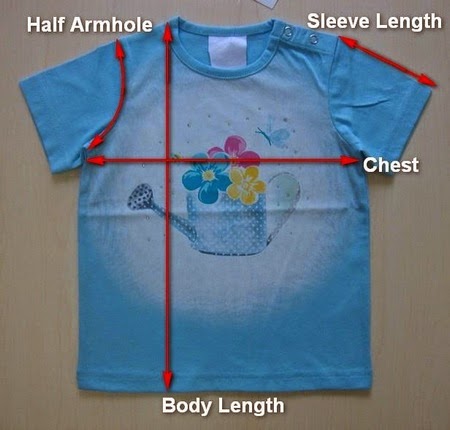 |
| T-shirt & its measurement |
Note: A shirt or pant with more
parts like collar, pocket, cuff etc. then we’ve to figure out
consumption of each parts separately, and finally we need add all
consumptions together. One more important thing, I didn’t mention sewing
allowance during fabric consumption of product. You have to add sewing
allowance with each measurement point during fabric consumption.
25. Suppose, we've made a marker of 5
pcs shirts to cut fabrics. we see, marker length 7 yards 4 inches,
marker width 60 inches, fabric GSM 180, now figure out Marker
Consumption & Fabric Consumption in Dozen ?
Answer: Marker Consumption: (7 x
36 + 4) x 60 x 180 / 1550000 = 1.78 KGs You see, firstly I’ve converted
Marker Length into inches (7 x 36 + 4) as 36 inches = 1 yard.
Formula: marker length X marker width X GSM / 1550000
Fabric Consumption in dozen: (7 x 36 + 4) x 60 x 180 / 1550000 / 5 x 12 = 4.28 KGs. Formula: marker consumption / pcs X 12
So, we see,
KG = length X width X GSM / 1550000
Or, Length = KG x 1550000 / width / GSM
Or, Width = KG x 1550000 / length / GSM
Or, GSM = KG x 1550000 / length / width (Please add wastage minimum 5% with all outcome).
E. Thread Consumption:
We often need figure out thread
consumption of various items like Shirt, Shorts, Tank tops and Pants
etc. Thread consumption means how much thread we need to stitch a
product. To figure out thread consumption, we’ve to pay concentration on
sewing machines, number of needles, fabric thickness & above all
how much thread is used to stitch 1 inch by a machine. And you need
consider minimum 10% wastage to find out thread consumption of a
product. Information below shows you how much threads you need to stitch
1 inch of fabric. It differs fabric to fabric as on their GSM &
construction. Besides you can stitch 10 inches of a fabric, then cut 1
inch stitch, measure the length of each thread, then figure out total
length of threads & finally add wastage minimum 10%. We know, it’s a
long process. Better we can memorize information below & imagine
wastage depending on fabric GSM. For fabric with high GSM, we’ve to
increase wastage percentage. If we want to figure out thread consumption
of a shirt, then firstly we’ve to separate
the different stitching of that shirt. Look information below for how
much thread you need to stitch one inch fabric by different sewing
machines.
Single Needle Plain Machine needs 2.75 inches thread for per inch stitch
- 2 Needles Plain Machine = 5.5 inches for per inch stitch
- 3 Threads Over lock Machine = 15 inches thread for per inch stitch
- 4 Threads Over lock Machine = 19 inches thread for per inch stitch
- 5 Threads Over lock M/c = 23 inches for per inch stitch
- Safety Stitch = 20 inches for per inch stitch
- Flat lock Stitch = 32 inches for per inch stitch
- 2 Needle Kansai M/c = 12 inches for per inch stitch
- 1 Needle Chain Stitches = 5 inches for per inch stitch
- Feed of the Arm M/c = 11 inches for per inch stitch
- Button Hole = 24 inches for per inch stitch
- Bar take M/c = 26 inches for per inch stitch
- Button Stitch of 2 Eyes (holes) = 3 inches thread
- Button Stitch of 4 Eyes (holes) = 6 inches thread
26. A shirt having 104 inches 4
Threads Over lock stitches, 52 inches Flat lock stitches, 20 inches 1
Needle Chain stitches, 15 inches Single Needle Plain Machine stitches,
GSM is normal, find out its thread consumption in meters?
Answer: {(104 x 19) + (52 x 32) + (20 x 5) + (15 x 2.75) + 10%} / 39.37 = 106.71 Meters. (39.37 inches = 1 Meter)
27. Suppose, we want to buy thread
cones with 2000 meters thread, now figure out how many cones do we need
to stitch 3000 pcs of garments, per garment’s thread consumption 106.71
meters?
Answer: 106.71 x 3000 / 2000 = 160 cones.
You can also visit following website that will provide you excel files for calculating thread consumption of different product.
F. Carton Consumption & Pricing:
28. A carton with Length 60cm, Width 40cm & Height 30cm, figure out a Cargo Measurement for 208 cartons?
Answer: 60 x 40 x 30 / 1000000 x 208 = 14.976 CBM
Formula: length X width X height / 1000000 X carton quantity
29. A carton of 7 Ply, Length 80cm,
Width 60cm, Height 30cm, total carton 120 pcs, find out carton
measurement in square meter ?
Answer: (80 + 60 + 6) x (60 + 30 + 4) x 2 / 10000 x 120 =329 Square Meters.
Formula: (length + width + wastage) X (width + height + wastage) x 2 / 10000 X carton quantity. (You can avoid wastage, if you wish)
30. 3 ply carton’s per square
(100 x 100) meter’s rate is USD 0.20, carton’s length is 60cm, width
40cm, height 30cm, total required carton quantity is 150 Pcs, figure out
price of total cartons?
Answer: (60 + 40 + 6) x (40 + 20 + 4) x 2 / 10000 x 150 x 0.20 = 48.70 USD.
Formula: (length + width + wastage) X (width + height + wastage) x 2 / 10000 X carton quantity X price
G. Poly Bags Consumption & Costing:
Most used poly bags in garments
industries are PP (polypropylene) poly bags, PE (polyethylene) &
LDPE (low density polyethylene), HDPE (high density polyethylene) etc.
Basically there’re three different ways to measure poly bags thickness.
- Mil (1 mil = 1/1000 of an inch)
- Microns (1 microns = 1/1000 of a mm)
- Gauge (1 gauge = 1/100000 of an inch)
Conversion, 1 mil = 25 microns = 100 gauge.
Note: Gauge is the most used system of counting poly bags’ thickness worldwide.
31. A poly bags having length 30
inches, flap 3 inches, width 16 inches, poly thickness 150 gauge. Now
find out weight of 1000 pcs poly bags?
Answer: {(30 + 1.5) x 16 x 150 / 3300} = 22.91 KGs for 1000 pcs
Formula: KGs needed for 1000 pcs poly bags = {(length + half flap) X width X gauge / 3300}
Now, if we want to find out weight of 1 pcs poly bag, then we need divide the outcome with 1000.
Answer: 22.91 / 1000 = 0.023 KGs. (1 pcs poly bag weight)
Note: You see, I count flap
measurement in half (1.5 inches) during calculation because flap is
single layer & length, width of a poly bag is double layer.
32. Now the question is 1 lbs. polymer price is 0.40 USD, find out cost of 22.91 KGs polymer?
Answer: 22.91 x 2.2 x 0.40 = 20.16 USD. (1 KG = 2.2 lbs.)
33. A poly bags having length 30
inches, flap 3 inches, width 16 inches, poly thickness 150 gauge. 1 lbs.
polymer price is 40 taka. Now find out cost of 1 pcs poly bag?
Answer: {(30 + 1.5) x 16 x 150 / 3300 / 1000 x 2.2 x 40} = 2.01 taka
H. Button Linear & Button Counting:
34. Figure out ligne of a button with 10mm Dia?
Answer: 10 / 0.635 = 15.75 ligne or 16 L (L means ligne)
Formula: Button Dia in mm / 0.635 or 1 / 0.635 x button Dia in mm
35. Per shirt has 6 buttons, total order quantity 3456 pcs, figure out total button quantity in GG ?
Answer: 6 x 3456 / 1728 = 12 GG. Formula: number of buttons per product X order quantity / 1728 (1 GG = 1728 pcs)
Note: We need add some extra
quantity (minimum 3%) while counting buttons for an order to save us
from risk in case of shortage due to defective & damaged.
Memorize the information below regarding button.
Button Linear or Button Length: 1 inches = 40 ligne = 2.54 cm, 1 ligne = 0.635 mm
12 Pcs = 1 Dozen, 12 Dozen = 1 Gross, 12 Gross = 1 GG (1728 pcs).
I. Threads Length Calculations:
36. If I question you to figure out
length of 2 lbs. (pound) single cotton threads? Then the question will
be so tough for few of us to solve. So, we first need know information
below. Then the question will be so nice & easy.
- 1 lb. single cotton thread length = 840 yards
- 1 lb. single linen / viscose thread length = 300 yards
- 1 lb. single wool thread length = 300 yards
- 1 lb. single silk thread length = 840 yards
- 1 lb. single acrylic thread length = 560 yards
Answer: 2 x 840 = 1680 yards. (As we knew from above information that 1 lb. single cotton thread length = 840 yards)
37. Figure out Length of 2 lbs. 16s (sixteen single) cotton thread?
Answer: 2 x 16 x 840 = 26880 yards. (1 lb. single (1) cotton thread length = 840 yards)
Therefore, Sixteen Single (16s) = 16 x 840 = 13440 yards = 1 lb.
Note: The count of yarn (thread)
will be increased, then the thickness of yarn will be decreased. Just
practice it more & more to make you perfect.
J. Sweater Gauge Counting & Yarn Consumption:
In knitting, the word gauge is used both
in hand knitting and machine knitting. Technical abbreviation is GG,
refers to "Knitting Machines" fineness size. In both cases, the term
refers to the number of stitches per inch, not the size of the finished
garment. In both cases, the gauge is measured by counting the number of
stitches (in hand knitting) or the number of needles (on a knitting
machine bed) over several inches then dividing by the number of inches
in the width of the fabric.
See image below to know how to count Knitting Gauge.
 |
| Knitting Gauge |
38. Now question is - A sweater has 50 stitches on 4 inches fabric, find out its gauge (GG)?
Answer: 50 / 4 = 12.5 (That means the sweater belongs to 12 GG).
Otherwise, we can memorize the
information below to identify sweater’s knitting gauge by yarn (Count
and Ply). I’m not a sweater expert, you can discuss with expert for more
information. (If you need).
Sweaters GG
Gauge
|
Count & Ply
|
Count & Ply
|
3 GG
|
2/16 4 plies
|
5 GG
|
2/16 3 plies
|
7 GG
|
2/16 2 plies
|
10 GG
|
2/32 3 plies
|
12 GG
|
2/32 2 plies
|
2/16 1ply
|
Note: To figure out yarn consumption of sweater, you’ve to add minimum 10% wastage. See calculation below as reference.
39. Sweater’s color is white, order
quantity 5000 pcs, yarn consumption in dozen 11.5 lbs. how many lbs. of
yarn you need for this order?
Answer: 11.5 / 12 x 5000 + 10% = 5324 lbs. Formula: yarn consumption dozen / 12 x 5000 + 10% (wastage)
K. Garments CM (Cost of Manufacturing) Calculation:
CM means Cost of Manufacture. It
actually means Manufacturing Cost of 1 Dozen (12 pcs garments). To
calculate Manufacturing Cost of 1 dozen knit garments of a specific
order we’ve to know the topics below:
- Monthly expense of factory,
- Total running machine,
- Machine quantity to execute the layout of mentioned order,
- Daily (8 hour per day) productivity of the order,
- Dollar conversion rate (if monthly expense is different from USD)
Suppose,
- Monthly Factory Expense = 50,00,000 Taka
- Working days of the month = 26 days
- Daily Factory Expense: 50,00,000 / 26 = 1,92,307.69 Taka. Formula: monthly factory expense / working days in the month
- Total running machine quantity = 150 Machines
- Daily Expense of 1 Machine: 192307.69 / 150 = 1282.05 Taka. Formula: daily factory expense / total running machine
- Machine quantity of layout for mentioned order = 27
- Daily cost for the layout: 1282.05 x 27 = 34,615 Taka. Formula: daily expenditure of 1 machine X Machine qty for the layout
Suppose,
- Hourly production of the layout = 125 pcs
- Normal daily working hour = 8 hours
- So, Daily Production of the layout: 125 x 8 = 1000 pcs. Formula: hourly production of the layout X normal daily working hour
- Manufacturing cost of 1pc: 34615 / 1000 = 34.62 Taka. Formula: daily cost for the layout / daily production of the layout
- So, CM (Manufacturing Cost of 12 pcs garments): 34.62 x 12 = 415.44 Taka. Formula: manufacturing cost of 1pc x 12
- Dollar conversion rate: 1 US Dollar = 77.30 Bangladeshi Taka.
- So, CM (Manufacturing Cost of 12 pcs garments) in US Dollar: 415.44 / 77.30 = 5.37 US$
- 20% profit would be added with CM: 5.37 x 20% = 1.07 US$
- So, Final CM = 5.37 + 1.07 = 6.44 US$.
L. Garments Costing Formula:
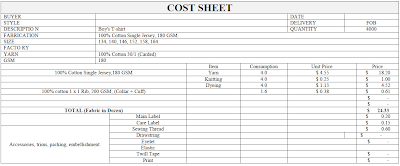
For garments costing, one needs to have
clear concept of the raw materials’ price & CM calculation of
garments. Following one is the sample costing sheet of knit garments. If
you need this sheet in excel file, then mail me. This sheet will give
you a basic clear concept regarding garments costing. As garments
costing depends on various aspects, so there is no specific formula for
garments costing except this sheet.
(Click on Image for large size)
I have so many questions to ask. I’m
leaving those upon you. Make questions & solve them by yourself.
It’s time to say you good bye. Let me finish here today as I have many
things to do now. Sorry, I can’t revise my writings due to lack of time.
I beg your pardon again if anything wrong & boring. See you soon
with so many questions & answers again. Wish you best of luck.