Search This Blog

Saturday, 1 December 2018

Carbon Fibre – strong, stiff, & light weight fibres

Properties, process, history, and application of carbon fibres

Carbon fibres are extremely strong, thin fibre, made of aligned carbon crystals with the shape of a honeycomb and consisting of long, chainlike molecules of pure carbon that are made by charring synthetic fibres such as rayon in the absence of oxygen.
The carbon fibres are ideally used where strength, stiffness, lighter weight and outstanding fatigue properties are of critical importance. They are also used where high temperature, chemical inertness and high damping are essential. widely used in commercial and civilian aircraft, recreational, industrial, and transportation markets.

A brief history of Carbon Fibres

Thomas Edison invented the electrical bulb during 1879 and he used cotton threads/bamboo slivers at very high temperatures in an enclosed glass tube which cuts off oxygen supply and threads were backed which carbonized them into carbon fibre filament. Roger Bacon was the first to create the carbon fibre from polyacrylonitrile (PAN) during 1958 and discovered its tensile strength.
About 85 to 90% of fibres are made from polyacrylonitrile and remaining are made from rayon or petroleum pitch. All of these materials are organic polymers, characterized by long strings of molecules bound together by carbon atoms.
US Airforce and NASA began using carbon fibre for its applications to aircraft and spacecraft. Carbon fibre and Kevlar fibres are materials that are used for making bulletproof vests protective inserts etc. They are known to be the most composite materials along with glass fibres and are strong and functions extremely well.
In comparison, steel has a tensile modulus of about 29 million psi (200 million kPa) thus, the strongest carbon fibres made are ten times stronger than steel and eight times that of aluminium, and are much lighter than both materials, 5 and 1.5 times respectively.

DEFINITION OF CARBON FIBER

  1. A material consisting of thin, strong crystalline filaments of carbon, used as a strengthening material, especially in resins and ceramics.
  2. a very strong lightweight synthetic fiber made especially by carbonizing acrylic fiber at high temperatures; also: a material made from such fibers embedded in a resinous matrix
  3. a strong, stiff, thin fiber of nearly pure carbon, made by subjecting various organic raw materials to high temperatures, combined with synthetic resins to produce a strong, lightweight material used in construction of aircraft and spacecraft.
carbon-fiber-properties
Carbon fiber preparations

How is Carbon Fiber Made?

An extremely strong, thin fibre, made of aligned carbon crystals with a shape of a honeycomb and consisting of long, chainlike molecules of pure carbon that are made by charring synthetic fibres such as rayon in the absence of oxygen. Carbon fibres are used in high-strength composite materials in aircraft, automobiles, architectural structures, and in other applications where light materials capable of withstanding high stress are required. These crystals organize themselves in long flattened ribbons and are used to produce carbon fibres. We call it precursor.
carbon-fiber-precursor
Precursor — polyacrylonitrile (PAN) is raw material to make 90% of carbon fibres. The remaining 10% is made from rayon or petroleum pitch. All of these materials used are organic polymers, characterized by long strings of molecules bound together by carbon atoms. The exact composition of each precursor prepared varies from one company to another company and is generally considered a trade secret.
During the manufacturing process, a variety of gases and liquids are used. The design of the material is prepared to react with the fibre to achieve a specific planned effect. Other materials are designed not to react or to prevent certain reactions with the fibre. As with the precursors, the exact compositions of many of these process materials are proprietary.
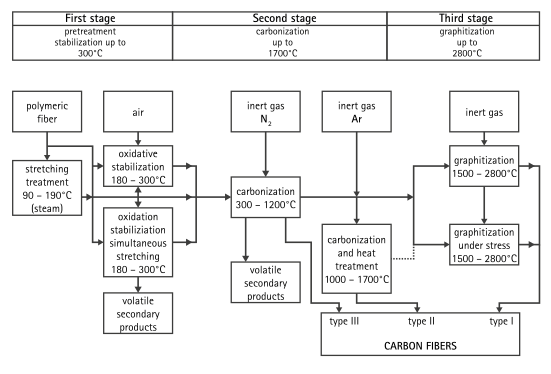
The process for making carbon fibres is a combination of partly chemical and partly mechanical. The precursor is drawn into long strands, ribbon’s or fibres and then heated to a very high temperature under enclosed conditions without allowing it to come in contact with oxygen.
Without oxygen, the fibre cannot burn. Instead, the high temperature causes the atoms in the fibre to vibrate violently until most of the non-carbon atoms are expelled. This process is called carbonization and leaves a fibre composed of long, tightly interlocked chains of carbon atoms with only a few non-carbon atoms remaining.
While ZOLTEK – carbon fibre manufacturing company has its own trade secrets and we’re also eager to encourage a broader understanding of carbon fibre as an ideal material for commercial use.

Stabilizing

Before the fibres are carbonized, they need to be chemically altered to convert their linear atomic bonding to a more thermally stable ladder bonding. This is accomplished by heating the fibres in air to about 390-590° F (200-300° C) for 30-120 minutes. This causes the fibres to pick up oxygen molecules from the air and rearrange their atomic bonding pattern. The stabilizing chemical reactions are complex and involve several steps, some of which occur simultaneously. They also generate their own heat, which must be controlled to avoid overheating the fibres.

Commercially, the stabilization process uses a variety of equipment and techniques. In some processes, the fibres are drawn through a series of heated chambers. In others, the fibres pass over hot rollers and through beds of loose materials held in suspension by a flow of hot air. Some processes use heated air mixed with certain gases that chemically accelerate the stabilization.

Carbonizing

Once the fibres are stabilized, they are heated to a temperature of about 1,830-5,500° F (1,000-3,000° C) for several minutes in a furnace filled with a gas mixture that does not contain oxygen. The lack of oxygen prevents the fibres from burning in the very high temperatures.
The gas pressure inside the furnace is kept higher than the outside air pressure and the points where the fibres enter and exit the furnace are sealed to keep oxygen from entering. As the fibres are heated, they begin to lose their non-carbon atoms, plus a few carbon atoms, in the form of various gases including water vapour, ammonia, carbon monoxide, carbon dioxide, hydrogen, nitrogen, and others.
As the non-carbon atoms are expelled, the remaining carbon atoms form tightly bonded carbon crystals that are aligned more or less parallel to the long axis of the fibre. In some processes, two furnaces operating at two different temperatures are used to better control the rate of heating during carbonization.

Treatment of the surface

After carbonizing, the fibres have a surface that does not bond well with the epoxies and other materials used in composite materials. To give the fibres better bonding properties, their surface is slightly oxidized. The addition of oxygen atoms to the surface provides better chemical bonding properties and also etches and roughens the surface for better mechanical bonding properties.
Oxidation can be achieved by immersing the fibres in various gases such as air, carbon dioxide, or ozone; or in various liquids such as sodium hypochlorite or nitric acid. The fibres can also be coated through electrolysis process where fibres are making the positive terminal in a bath filled with various electrically conductive materials.
The surface treatment process must be carefully controlled to avoid forming tiny surface defects, such as pits, which could cause fibre failure.

Sizing

After the surface treatment, the fibres are coated to protect them from damage during winding or weaving. This process is called sizing. Coating materials are chosen to be compatible with the adhesive used to form composite materials. Typical coating materials include epoxy, polyester, nylon, urethane, and others.
The coated fibres are wound onto cylinders called bobbins. The bobbins are loaded into a spinning machine and the fibres are twisted into yarns of various sizes.

Physical/chemical/mechanical properties of carbon fibres

  • Tenacity—1.8 —2.4 (kn/mm2)
  • Density—-1.95 gms/c.c
  • Elongation at break—-0.5%
  • Elasticity —not good
  • Moisture regain (M. R%)—-0%
  • Resilience—–Not good
  • Ability to protest friction—-Good
  • Colour—-Black
  • Ability to protest heat—–Good
  • Lustre—–Like silky
  • Carbon is a poor conductor of electricity because it is a nonmetal, which in general are poor conductors of electricity.
  • Carbon Fiber has High specific Strength to Weight Ratio
  • Carbon Fiber is very Rigid
  • Carbon fibre is Corrosion Resistant and Chemically Stable.
  • Carbon fibre is Electrically Conductive
  • Fatigue Resistance is good
  • Carbon Fiber has good Tensile Strength
  • Carbon fibre is Fire Resistance/Non-Flammable
  • Thermal Conductivity of Carbon Fiber–it is not possible to pinpoint exactly the thermal conductivity. Special types of Carbon Fiber have been specifically designed for high or low thermal conductivity.
  • Low Coefficient of Thermal Expansion–Carbon fibre can have a broad range and can be designed as per final requirement.
  • Non-Poisonous, Biologically Inert, X-Ray Permeable–These qualities make Carbon fibre useful in Medical applications
  • Carbon Fibers are brittle—The layers in the fibres are formed by strong covalent bonds.

Carbon Fiber is not yet geared to Amateur techniques.

In order to maximize Carbon Fiber Characteristics, a relatively high level of technical excellence must be achieved. Imperfections and air bubbles can significantly affect performance. Typically, autoclaves or vacuum equipment is required. Moulds and mandrels are major expenses as well.
The success of any amateur carbon fibre construction will be closely linked to the skill and care taken.

Chemical properties

  1. Effect of bleaching—-sodium hypochlorite slightly oxidized carbon fibres
  2. Effect of sunlight—-Do not change carbon fibres
  3. Protection against flame—–Excellent
  4. Protection ability against insects——Do not harm carbon fibres.

Carbon fibres are available in different forms

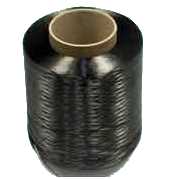
  1. Towscarbon-fiber-tows

    This tow gives a measure of its number of filaments per bundle. Small Tow has 24000 or fewer filaments, Large tow has 48000 to 320000 filaments and sometimes more. Normally is sold in large spools.
    Often Carbon tow is used in winding tubes and other structures, selectively reinforcing structures and used in compression moulding. It can be used in chop guns but fibreglass can usually be substituted effectively.
  2. Tapes

    Carbon fibre tape is available in 2″ wide 15feet long. Carbon tapes are used for reinforcement of carbon parts. It is easier to buy in this form than to cut your own stripes.
  3. Roving’s

    Carbon fibre is offered as bundled fibres. These are not woven but rather are bunches of unidirectional filaments. The terms Tow, Roving and Strand is more a measure of how large the bundle of fibre is than of actual differences in the form.
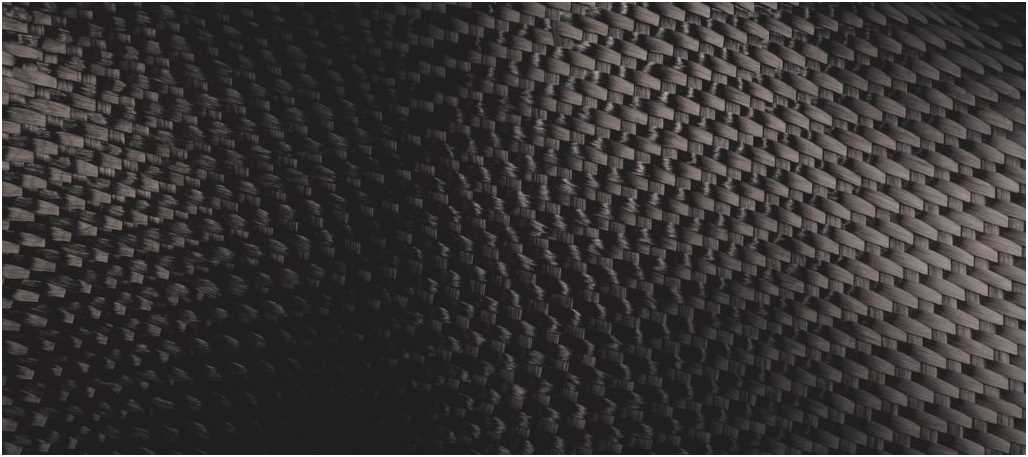
  4. Woven cloth

    carbon-fiber-plain-weave
    plain weave
    carbon-fiber-twill-weave
    twill weave
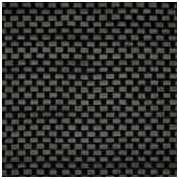
    Cloth comes in many weights and wide ranges are available. Home builders usually deal with 3.5-12 ounces per square yard. but other weights are possible.
    There are many types of weave. Most home builders are familiar with the plain weave. It is the easiest of weaves to wet out.
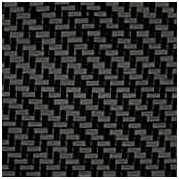
    Twill weaves (right) are also available. Twill weave usually has the fibres spanning 2 fibres. It makes it easier to form to a shape. Twill weave is reputed to be slightly stronger than plain weave. It is certainly very showy.
    Because the fibres bend up and down as they follow the weave there is a slight decrease in strength when compared with the uniaxial cloth that is made so that all the fibres run one way (except for the few that keep the cloth together.)
  5. Matting or Felt

    It is possible to find felted Carbon fibre but its use is not for reinforcement of matrix. IT has used in heat protection and safety applications. Home builders looking for a matted material normally use fibreglass.
  6. Carbon Fiber Veil

    Used in making corrosion resistant barriers and for grounding composite structures and minimizing static electricity build-up. The nonwoven structure allows a resin-rich surface that increases chemical stability and reduces micro-crack formation in the composite surface.
  7. Carbon fibre sleeves or socks

    carbon-fiber-tubes
    Carbon fibre tubes
    carbon-fiber-plain-mast
    Carbon fibre plain mast
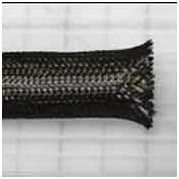
    These are available in 2 forms, either biaxially woven or unidirectional, with minimal stitching to keep the tube together until impregnated. These are very useful if making tubes or round pipes or masts. In the woven tubes, the fibres end up running diagonally along the tube. Woven tubes are very adjustable and can be used for several sizes simply by compressing lengthwise or stretching. This allows for tapered construction or for curves.
    Unidirectional tubing has the fibres running lengthwise only. This allows the composite to be reinforced in the longitudinal direction. Uniaxial tubes need to be bought in the right size since there is no stretch.
    Using these tubes simplifies making pipes, tubes and dinghy masts but they are quite expensive.
  8. Coatings and surface treatment

    In order to improve adhesion to the resin matrix, Carbon Fiber is sometimes surface treated. By partially oxidizing the fibre to make it more chemically active. Other coatings or treatments exist to modify the fibre’s handling such as polymer coatings.
  9. Hybrid or Combinations

    Carbon Fibre is sometimes combined with other fibres to modify its characteristics or to reduce cost.
    One of the most common combinations is with Kevlar. Since Kevlar can be dyed, several companies now offer coloured carbon fibre – Kevlar fabrics.
    When combining carbon fibre with metal it is good to remember that it is electrically conductive and can be involved in galvanic corrosion. The so-called Silver Carbon Fiber is actually aluminium and fibreglass.

Applications of Carbon Fiber Overview:

Reference – Todd Johnson, Updated March 30, 2017
Every day, a new application is found for carbon fibre. What started out forty years ago as a highly exotic material is now a part of our everyday lives. These thin filaments, a tenth of the thickness of a human hair, are now available in a wide range of useful forms. The fibres are bundled, woven and shaped into tubes and sheets (up to ½” thick) for construction purposes, supplied as cloth for moulding, or just regular thread for filament winding.
  1. Carbon Fiber in Flight

    Carbon fibre has gone to the moon on spacecraft, but it is also used widely in aircraft components and structures, where its superior strength to weight ratio far exceeds that of any metal. 30% of all carbon fibre is used in the aerospace industry. From helicopters to gliders, fighter jets to microlights, carbon fibre is playing its part, increasing range and simplifying maintenance.
  2. Sporting Goods

    Its application in sports goods ranges from the stiffening of running shoes to ice hockey stick, tennis racquets, and golf clubs. ‘Shells’ (hulls for rowing) are built from it, and many lives have been saved on motor racing circuits by its strength and damage tolerance in body structures. It is used in crash helmets too, for rock climbers, horse riders, and motorcyclists – in fact in any sport where there is a danger of head injury.
  3. Military

    The applications in the military are very wide ranging – from planes and missiles to protective helmets, providing strengthening and weight reduction across all military equipment.
    It takes energy to move weight – whether it is a soldier’s personal gear or a field hospital, and weight saved means more weight moved per gallon of gas.
    A new military application is announced almost every day. Perhaps the latest and most exotic military application is for small flapping wings on miniaturized flying drones, used for surveillance missions.
  4. Carbon Fiber at Home

    Areas as broad as your imagination, whether it is style or practical application. For those who are style-conscious, it is often tagged as ‘the new black’. If you want a shiny black bathtub built from carbon fibre or a coffee table then you can have just that, off the shelf. iPhone cases, pens, and even bow ties – the look of carbon fibre is unique and sexy.
  5. Medical Applications

    Carbon fibre offers several advantages over other materials in the medical field, including the fact that it is ‘radiolucent’ shows as black on X-ray images. It is used widely in imaging equipment structures to support limbs being X-rayed or treated with radiation.
    The use of carbon fibre to strengthen damaged cruciate ligaments in the knee is being researched, but probably the most well-known medical use is that of prosthetics – artificial limbs. South African athlete Oscar Pistorius brought carbon fibre limbs to prominence when the International Association of Athletics Federations failed to ban him from competing in the Beijing Olympics.
    His controversial carbon fibre right leg was said to give him an unfair advantage, and there is still considerable debate about this.
  6. Automobile Industry

    As costs come down, carbon fibre is being more widely adopted in automobiles. Supercar bodies are built now, but its wider use is likely to be on internal components such as instrument housings and seat frames.
  7. Environmental Applications

    As a chemical purifier, carbon is a powerful absorbent. When it comes to absorption of noxious or unpleasant chemicals, then surface area is important. For a given weight of carbon, thin filaments have far more surface area than granules. Although we see activated carbon granules used as pet litter and for water purification, the potential for wider environmental use is clear.

Introduction to breathable water-repellent textiles and their production methods

Type of Breathable textile materials | Methods of producing Breathable textiles

Breathability refers to the ability of a fabric to absorb moisture and release it through the material itself, allowing it to ‘breathe’. Breathable Fabrics transmit body moisture away from the body, thus maximizing comfort and dryness during outdoor activities.

Waterproof Vs. Water Repellent Vs. Water Resistant

This looks above three terms are alike but there is a difference between waterproof, water repellent and water resistant. We must at the very beginning distinguish between “waterproof” and “water-repellent” textile surfaces.  When you start to add breathability into the mix, things can start to get a little complicated. So, you should have clarified what do they all mean and why should you take note of the differences?

Definitions

Waterproof

  1. Waterproof fabrics are fabrics that are inherently or have been treated to become, resistant to penetration by water and wetting. The term “waterproof” refers to conformance to a governing specification and specific conditions of a laboratory test method.
    Even when you put pressure on a waterproof garment, it will still be impervious to water. The amount of pressure you can put on the garment before you start to get wet varies, and you can find out what that amount is by checking the garment’s water column.

Water Repellent

Water-repellent treatment is a standard finishing process for modern textiles in order to create breathable textiles. Water-repellent agents exploit the high-water repellency of silicones without impairing the textiles’ ability to breathe. Additionally, they confer a soft hand on textiles.
Water repellency is, therefore, a step up from water resistance. This means that water can’t easily penetrate the material (the technical term is that it’s hydrophobic).
Meaning:
  • Not easily penetrated by water, especially as a result of being treated for such a purpose with a surface coating.  It beads on the outside instead. The fabric is a densely woven and it offers some water resistance.
  • Adjective (of fabrics, garments, etc) having a finish that resists the absorption of water
  • Adjective having a finish that resists but is not impervious to water.
  • Water-repellent clothing or material does not absorb water when it is raining lightly
  • Able to keep rain from being absorbed.

Water Resistant

This offers the lowest level of water protection. If a garment resists water, it’s usually because the fabric itself is acting as a barrier between you and a light shower. Tightly woven fabrics will offer a degree of water resistance, as it takes some time for the water to seep through the material.
Adjective
  1. Able to resist the penetration of water to some degree but not entirely
  2. Resisting though not entirely prevent the penetration of water.

The Definition of Breathability

In a nutshell, breathability refers to the ability of a fabric to absorb moisture and release it through the material itself, allowing it to ‘breathe’. Breathable means that a fabric permits perspiration vapors to escape from the body through the fabric. During strenuous activity, the body releases moisture vapors, and the skin breathes this moisture as it naturally tries to cool itself down.
Breathable Fabrics transmit body moisture away from the body, thus maximizing comfort and dryness during outdoor activities. This continuous cycle of motion is at the heart of the mechanism of breathability: the more you sweat inside a breathable clothing item, the higher its perspiring capacity should be, and this circular action never stops.

Breathability does not, as the term might imply, relate to an exchange of air. Instead, it is the ability of a fabric to allow moisture vapor to pass through it. A fabric may carry this out in numerous different ways, and exchange of air is only one possible avenue. Moisture vapor permeability (MVP) and moisture vapor transmission (MVT) are perhaps better, and certainly more technical, terms to use than breathability. Neither ASTM nor the Textile Institute defines breathability, but MVP and MVT are both defined in test standards.
Air permeability is intrinsically linked to breathability. Air permeability is “the velocity of an air flow passing perpendicularly through a test specimen under specified conditions of the test area, pressure drop, and time” (according to BS EN ISO 9237: 1995). All air permeable fabrics are breathable to some extent, though not all breathable fabrics are air permeable.

Application of durable water-repellent finishes by coating methods

Measuring the surface tension of the liquid, one may calculate the work of adhesion between the liquid and the surface of the solid. It is clear that the smaller the work of adhesion, the smaller will be the wettability and the greater will be the repellency.

What is water repellent finish?

The durability of Water-Repellent Finishes

Durable water repellent, or DWR, is a coating added to fabrics at the factory to make them water-resistant (or hydrophobic). Durable water repellents are commonly used in conjunction with waterproof breathable fabrics such as Gore-Tex to prevent the outer layer of fabric from becoming saturated with water.
A durable water repellent (DWR) is a functional finish for fabrics, which adds water-shedding properties to existing products. Garments treated with a DWR bead water droplets and force water to roll off the surface of the fabric.
The DWR, as the name suggests, repels water, i.e. water droplets form on the outer surface (as we stated above). And this plays an important role in breathability. When we say a jacket is “breathable”, we don’t actually mean it breathes. What we really mean is that it transports moisture – sweat – from the inside to the outside of the jacket.
For moisture to move from the inside to the outside but not the other way around, the face fabric can’t be soaked in water. As we stated above, hydrophilic fabrics on their own keep you dry from rain from the outside – as they soak it up – but they won’t keep you dry from your own sweat from the inside. So, it’s the combination of a hydrophilic material and a DWR that makes a jacket waterproof and breathable.
Hydrophilic fabrics are also impregnated with a durable water repellent (DWR). But if they inherently stop water reaching your skin, why do you need a DWR? Good question!
We did say this would get a little complicated! But what you need to take away from this is:
  • Waterproofness is what you need to look for if you plan on wearing your gear in rainy or snowy conditions
  • Breathability – i.e. transporting your sweat away from your skin – usually goes hand-in-hand with waterproofness
  • Water repellency offers light rain resistance thanks to the impregnation
  • Types of DWR Solutions
  • Fluorine-free
  • Fluorine-free DWR solutions are the future of water-repellency in the textile industry. These solutions contain no fluorochemicals, making them ultimate environmentally-friendly solutions for garments requiring water repellency.
  • C8/C6: This solution is a chemical compound made up of carbon and fluorine atoms. These atoms form a long chain (C8), which helps repel water and oil from fabrics. Due to concerns from the Environmental Protection Agency (EPA) on fluorochemicals, mostly concerning toxicity and human contact, textile manufacturers have moved away from incorporating this technology into their garments.  The fundamental difference between the C6 solutions and C8 is that the C6 solution contains fewer fluorochemicals, reducing the hazardous risk.

How DWRs Work

DWRs work by increasing the “contact angle” or “surface tension” created when water contacts a textile. Basically, a high contact angle creates a microscopically “spiky” surface that suspends water droplets on the outer fringe of the fabric.
breathable-fabrics-contact-angle
An optimized DWR keeps droplets in a rounded shape—like a dome-shaped bead. The rounder the droplet, the easier it rolls off the fabric. A low contact angle permits droplets to assume a flattering shape, one that can spread out like a splotch, cling to the fabric’s surface and eventually seep into it.

DWR Ratings

Manufacturers generally measure DWR effectiveness by a spray test. Water is sprayed onto a textile, and the amount that sticks is visually assessed. A score of 90 points indicated that roughly 90% of the fabric has no water sticking to it. The higher the number, the better the performance. The test is then repeated after a number of washings to determine durability.
Test scores and the number of washings is combined to create a rating. For example, a 90/10 rating means the spray test achieved a total of 90 points after 10 washes.
Not all manufacturers publish DWR performance ratings, but here is a basic guide for interpreting any that you find:
  • Good: 80 points after 10 washes. This is a basic outerwear finish.
  • Excellent: 80 points after 20 washes. Marmot, for example, uses this as its minimum rating for outerwear.
  • Superior: 80 points after 50 to 100 washes.

Fabric Production process and coating techniques

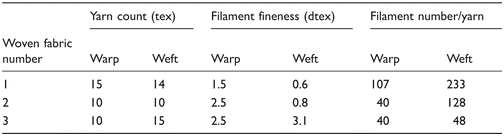
Fabric requirements need tendency of to resist wetting is a function of the chemical nature of the solid surface, the roughness of the surface, the porosity of the surface, and the presence of other molecules on the surface. Woven fabrics for water repellent/ water resistant/breathable textiles feature permeable pore channels between yarn interlocking points (mesopores), which create an increased risk of penetration by contaminated fluids and particles. These pore channels can be reduced in size by finer count and high-density weaving.
breathable-fabrics-mesopores-micropores
This, however, results in deteriorated drapability and performance characteristics. The barrier properties of the woven fabric are determined by the construction-dependent pore morphology (mesopores and micropores), and the surface character of the textile structures.
breathable-fabrics-warp-weft-count
When used for protective garments, it is equally important to guarantee high wearing comfort. Fulfilling these conflicting requirements (barrier effect and comfort) in a single textile structure is an immense challenge. To impede the penetration or pervasion of fluids, barrier textiles are finished with fluorocarbon (FC) resin.
The hydrophilizing by means of FC also reduces the adsorption of water on the fibers. Such woven fabrics only have an effective barrier function against fluids at small amounts of fluid, low pressures, and short exposure times. In the simplest case (sieve effect), the maximum pore sizes present in the woven fabric determines particle retention. In the case of smaller particles and larger pores, further barrier mechanisms are known, such as retention by bridging and by adhesive forces (van der Waals forces), or by electrostatic forces.
In microfilament woven fabrics, deep-bed filtration also plays an important role. Particles penetrating into the woven fabric interact with the filament surfaces and can be deposited between the woven fabric filaments. In order to fully exploit the advantages of woven fabrics as barrier textiles (good drapability, high wearing comfort), mesopores present primarily at the crossing points of warp and weft yarns in the woven fabric are to be reduced in size by a targeted finishing with fine microparticles so that the woven fabric meets the stated requirements.

Coating Methods

  1. Knife Coating (floating knife) or Direct Coating

    In Knife Coating, as seen in Figure 3, the liquid coating is applied to the fabric while being run at tension under a floating knife blade, the distance between the fabric and the knife blade determines the thickness of the coating. The blade can be angled and have different profiles to affect the coverage. For this process to be effective the liquid coating must be quite viscous in order to prevent it from soaking through the fabric, the coating is then dried or cured.
    This technique is best used for Filament yarns as the staple fibers in spun yarns can protrude on the surface creating an uneven finish, but this is dependent upon the thickness of the applied coating. For this type of coating to be most successful the weave structure has to be quite tight and the fabric capable of being held taught.
    breathable-fabrics-knife-coating
    Figure 3. Fung, W, 2002, Coated and Laminated Textiles, UK; Woodhead Publishing;
  2. Direct Roll Coating

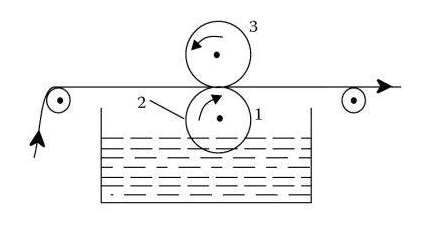
    In this process, the coating liquid is rolled onto the fabric by a roller suspended in the coating solution, often a blade is positioned close to the roller to ensure not too much coating solution is applied.
    breathable-fabrics-direct-roll-coating
    Figure 4. Direct Roll Coating from;Sen, A K, 2008, Coated Textiles; Principles and Applications, 2nd Edition, USA;Taylor and Francis.
  3. Pad-Dry-Cure

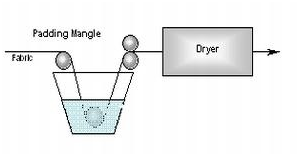
    Also referred to as Padding, this technique, widely regarded as a textile finishing technique, can, in fact, be used to add a variety of coatings, but this usually refers to a fiber coating for the application of micro or nanomaterials or chemical compositions.
    As shown in figure 5, the fabric is submerged in the coating solution then the excess squeezed out in the rollers, which dictates the pick-up percentage, the fabric is then dried and cured.
    breathable-fabrics-pad-dry-cure
    Figure 5
  4. Calender coating

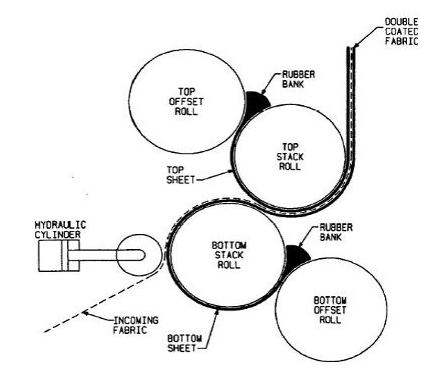
    Calender finishing involves the fabric passing through a set of heated rollers to singe off any surface fibers and add lustre and smoothness. Calender coating is the same principle in which the fabric passes through heated rollers, but through this process, a coating is applied as demonstrated in figure 6. This image demonstrates the simultaneous coating of both sides of the fabric with the thickness of the coating determined by the width of the nip in-between the rollers, more rollers used can provide a thinner coating.
    breathable-fabrics-calendar-coating
    Figure 6. Depicts calender coating. Image from; TPO coated PP fabrics and their applications
  5. Hot melt extrusion coating

    Hot melt extrusion coating is applied in the same process as calendaring with the coating being melted from granules fed to heated rollers which then nip the coating to the fabric. It is used to produce un-supported films and these freshly produced films are added directly to the fabric. Its uses are mainly for Thermoplastic polymers such as Polyurethane, Polyolefins, and PVC.
  6. Foam Finishing

    Foam finishing was developed as a more environmentally friendly version of the pad-dry-cure system, as the chemical applied requires less product in weight, but equates to a high surface area. Foam also ensures lesser wetting takes place, which requires less drying; furthermore, waste is reduced in terms of residual liquor. This technique is useful in coating heavy fabrics such as carpets and can be used to effectively coat only one side.

Test Method of Specified Requirements of Water Repellency Textiles

Water Repellent Textiles

Water repellent fabrics are processed with water repellent additives so that water droplets form on the surface but do not penetrate the fabric, a phenomenon known as “the lotus effect.” The efficiency of water repellency is graded in 6 ratings as 0, 50, 70, 80, 90 and 100. A standard test is usually performed after five launderings with water at a temperature of forty degrees Celsius. To qualify as water repellent, the fabric must perform to at least rating four (90% or better efficiency). Further tests for the endurance of water repellency may be performed after 20, 50 or 100 launderings at similar temperatures to the initial test. Water Repellency Textiles are commonly used in fabrics for windbreakers outer garments, umbrellas, furniture decorations to name just a few.
Taiwan technology for Water Repellent Textiles achieves rating 100 initially, and not less than rating 80 after 100 launderings. The test method employed is AATCC 22. The Optical Contact Angle for lotus leaf is 135°; ordinary water-repellency treatments reach 130°; ordinary nano-treatments achieve 140°. However, with Taiwan’s special nano-technology for functional textiles, the Optical Contact Angle reaches up to 150°.
  1. Scope

    This criterion defines the evaluation and testing of water repellency textiles. It is applicable to textiles with
    water-repellent finishes. However, it is not intended to measure penetration of water through the textiles.
  2. Terminology

    Water repellency: the characteristic of textile to resist surface wetting.
  3. Performance specification

    Grade classification
    100(ISO 5) Excellent
    90(ISO 4) Very Good
    80(ISO 3) Good
    70(ISO 2) —
    50(ISO 1) —
    0 —
  4. Test Method

    Water Repellency
  5. Test Specimens

    Three test specimens 180.0×180.0mm are needed and should be conditioned at 65+/-2% relative humidity and 20+/-2°C until moisture equilibrium.
  6. Test Procedure

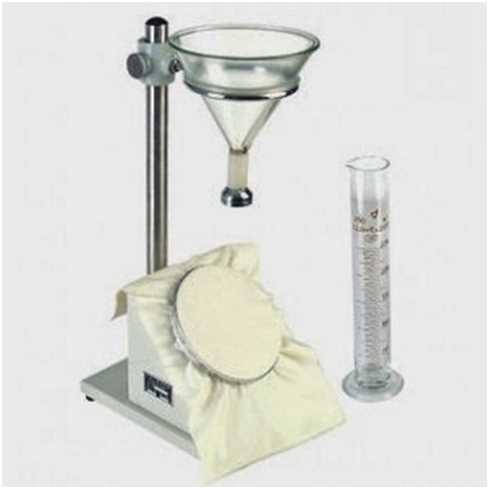
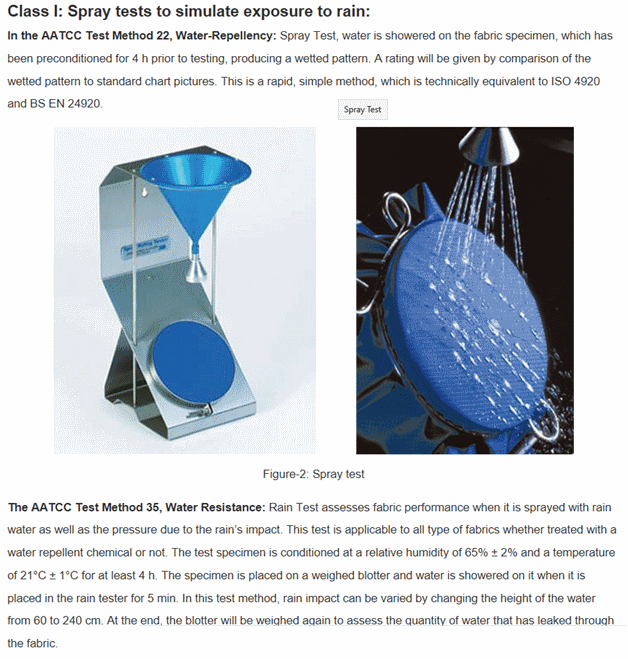
    • Fasten the test specimen securely in the 150+/-5 mm diameter hoop so that the face of the test specimen will be exposed to the water spray. The surface of the specimen should be smooth and without wrinkles. Place the hoop on the stand of the tester in 45° with the specimen uppermost in such a position that center of the spray pattern
      coincides with the center of the hoop. The distance should be 150+/-2 mm. Make sure that the warp direction of the test specimen should parallel to the watering direction.
    • Pour 250ml of distilled water into the funnel of the tester and allow it to spray onto the test specimen for 25 to 30 seconds. Take the hoop by the bottom edge and tap the opposite edge firmly once against a solid object with the fabric facing the object, then rotate the hoop 180° and tap once more on the point previously held.
    • Repeat the procedure above for other 2 specimens.
      breathable-fabrics-testing
    • Evaluation and Report After tapping, immediately compare the wet or spotted pattern with the rating chart. Rate the face of the specimen. Report the worst rating.
    • Washing requirement: Select the specified washing condition and drying method based on the suppliers’ provided care instruction.
    • Fill the washing machine with water to 18Gal (about 68L) and adjust the water temperature. Machine Cycle Washing Temperature Drying Procedure (1) Normal/Cotton Sturdy (2) Delicate (3) Permanent Press (II) 27+/-3°C
      (80+/-5°F) (III) 41+/-3°C (105+/-5°F) (IV) 49+/-3°C (120+/-5°F) (V) 60+/-3°C (140+/-5°F) (A) Tumble i. Cotton Sturdy ii. Delicate iii. Permanent Press (B) Line (C) Drip (D) Screen
    • Add 66+/-1g of 1993 AATCC Standard Reference Detergent to the washing machine. Then, add the test specimens and ballast (total weight: 1.8+/-0.1kg) into the machine. Set the washer for the selected washing cycle and time.
    • Remove the specimen after the final spin and dry the specimen according to the specified method. After drying, condition the specimens by laying each specimen separately on the screen in an atmosphere of 20+/-2°C and 65+/-2%
      RH. until it achieves moisture equilibrium.
      breathable-fabrics-testing
breathable-fabrics-spray-test

Summary and Conclusions

The theory of water repellency of textile fabrics has been reviewed with special references to the more recent theory of the wetting of fabrics by water. A survey has also been made on the various testing methods that have been devised for measuring water repellency. The results of the present investigation lead to the following conclusions regarding the status of water repellency. There is a definite need for a comprehensive study of the role that the structure of a fabric plays in the phenomena of water repellency. Students can take these projects and develop the products in their workshops, chemical laborite and test them in the testing laboratory.
In the past, the emphasis has been on developing more efficient compounds. Data available indicate that a better understanding of fabric construction as it applies to repellency, coupled with the now available water-repellent agents, will lead to some more nearly idealized type of water-repellent garment. In regard to testing methods, it is required that correlation is established between the Water-Repellent Fabrics results of laboratory test methods and performance of fabrics.
As already stated, the contact angle is influenced by the following factors: The’ chemical nature of the solid surface, the porosity of the surface, and the presence of other molecules on the surface. Again, any one or all of these factors could diminish the contact angle during wetting of the fabric. The change will indicate moisture regain of the sample which will show that the rate at which a fabric absorbs moisture increases the proportion to the number of times the sample has been wetted. It is of interest to re-exam the surface factors that might be responsible for the increase in moisture absorption.
The loss in the repellent agent, the change in position of the fibers in the yarns, and the creation of new surface could all affect the rate of water absorption. The swelling of partially coated or uncoated fibers would also result to make available more hydrophilic surfaces (OH groups). Now, a team at MIT has come up with a promising solution: a coating that not only adds water-repellency to natural fabrics such as cotton and silk but is also more effective than the existing coatings.
The new findings are described in the journal Advanced Functional Materials, in a paper by MIT professors Kripa Varanasi and Karen Gleason, former MIT postdoc Dan Soto, and two others.

Closing Remarks

Now that you know that “water-repellent” is a characteristic, and understand the differences between water-resistance and waterproofness in fabrics, you should have a newfound sense of reassured confidence when purchasing the perfect product that meets your needs. Being mindful of label descriptions can greatly assist you in deciding whether a product will be suitable for the conditions that you expose it to.

Cotton Fibers – the king of fibers

Cellulose, seed fiber from the nature

Cotton is a soft staple fibre that grown in a form known as a boll around the seeds of the cotton plant, a shrub native to tropical and subtropical regions.

Cotton


Cotton today is the most used textile fiber in the world. Its current market share is 56 percent for all fibers used for apparel and home furnishings and sold in the U.S. Another contribution is attributed to nonwoven textiles and personal care items. The earliest evidence of using cotton is from India and the date assigned to this fabric is 3000 B.C. There were also excavations of cotton fabrics of comparable age in Southern America. Cotton cultivation first spread from India to Egypt, China, and the South Pacific.
Cotton is a soft, staple fiber that grows in a form known as a boll around the seeds of the cotton plant, a shrub native to tropical and subtropical regions around the world, including the Americas, India, and Africa. The fiber most often is spun into yarn or thread and used to make a soft, breathable textile, which is the most widely used natural-fiber cloth in clothing today. The English name derives from the Arabic (al) qutn قُطْن , which began to be used circa 1400.
Each cotton fiber is composed of concentric layers. The cuticle layer on the fiber itself is separable from the fiber and consists of wax and pectin materials.

Properties of Cotton

cotton bollCotton is a soft fiber that grows around the seeds of the cotton plant. Cotton fiber grows in the seed pod or boll of the cotton plant. Each fiber is a single elongated cell that is flat twisted and ribbon-like with a wide inner hollow (lumen).
  • 90% cellulose, 6% moisture and the remainder fats and impurities.
  • The outer surface is covered with a protective wax-like coating which gives fiber an adhesive quality.
Cotton is a natural fiber that is grown in countries around the world. It is a crop that requires adequate moisture and heat to mature and produce quality fibers. Cotton growing tends to be in warmer climates. Cotton is a true commodity in the world markets and supply and demand truly affect prices of raw cotton.
Cotton fibers are mainly made up of cellulose. Cellulose does not form unless temperatures are over 70 °F (21 °C). The cotton fibers are attached to the seeds inside the boll of the plant. There are usually six or seven seeds in a boll and up to 20,000 fibers attached to each seed. The length of these fibers (also called staples) is the main determining factor in the quality of the cotton. In general, the longer the staple grows the higher the quality of the cotton. Staple lengths are divided into short, medium, and long (and extra long, in some cases):
  • Short staple cotton is between 3/8” to 15/16” (.95cm to 2.4cm) in length
  • Medium staple cotton is between 1” to 1-1/8” (2.54cm to 2.86cm) in length
  • Long staple cotton is between 1-3/16” to 2-1/2” (3cm to 6.35cm) in length

Properties of Cotton Products

  • Comfortable – there are no surface characteristics of cotton that make it irritating to human skin. Cotton feels good against skin; it has a soft hand.
  • Hydrophilic – cotton has a natural affinity for water – it attracts moisture away from your body.
  • Moisture passes freely through cotton – aiding in evaporation and cooling
  • Good Heat Conductivity – Cotton allows heat to dissipate making it a wonderful fiber to maintain a comfortable sleeping temperature.
  • Strong and abrasion resistance
  • The unfavorable attributes of cotton include its lack of resiliency (cotton tends to wrinkle) and its
    lack of luster (colors are usually dull).

Properties of Cotton Fiber

  • It has 8% moisture regain
  • The cellulose is arranged in a way that gives cotton unique properties of strength, durability, and absorbency
  • It is fresh, crisp, comfortable, absorbent, flexible, has no pilling problems and has good resistance to alkalis
  • It has poor wrinkle resistance, shrinkage, poor acid resistance, less abrasion resistance, susceptible to damage by moths and mildew, needs lots of maintenance and stains are difficult to remove
  • Its fiber length ranges from ½ inches to 2inches
  • It has 10%increase in strength when wet.
  • It has a flat twisted tube shape

Long Staple Cotton

In general, long staple cotton is needed to spin the yarns needed in the weaving of the finer down proof cotton fabrics.
Long staple cotton is considered to be finer quality because they can be spun into finer yarns and those finer yarns can be woven into softer, smoother, stronger, and more lustrous fabrics. Long staple cotton makes stronger yarns, especially in fine yarns, as there are fewer fibers in a given length of yarn and the longer fibers provide more points of contact between the fibers when they are twisted together in the spinning process.
Common areas that grow long staple cotton in the world would be Egypt, Sudan, the United States (Pima cotton grown in the west and southwest are long staple cotton), and Western China. The two most widely known long-staple cottons are Egyptian cotton and Pima cotton. Pima cotton is grown mainly in the United States, but also in Peru, Israel, and Australia.
The fibers are sent to a textile mill where carding machines turn the fibers into cotton yarn. The yarns are woven into cloth that is comfortable and easy to wash but does wrinkle easily. Cotton fabric will shrink about 3% when washed unless pre-treated to resist shrinking.

Cotton is prized for its comfort, easy care, and affordability and is ideal for clothing, bedding, towels, and furnishings.

Harvesting

cotton stipper machineCotton was once harvested by hand, often by slave labor or tenant farmers. As recently as 1965, over a fourth of the U.S. cotton crop was picked by hand. Today, harvesting cotton is highly mechanized.
Harvesting machines called strippers and pickers efficiently remove the cotton while leaving the plants undisturbed. Spindle harvester, also called a picker, has drums with spindles that pull the cotton from the boll in one or two rows at a time. Even a one-row mechanical picker can do the work formerly done by 40 hand pickers.
In stripper harvesting, the stripper moves along rows of plants, passing them between revolving rollers or brushes that pull off the cotton. Strippers also pull twigs and leaves with the cotton.
Cotton gins separate the fibers, called lint, from the seeds. After ginning, the cotton goes to the bale press that packs it into 480-pound bales about the size of a large refrigerator.

Classing Cotton

Cotton buyers judge cotton on the basis of samples cut from the bales. Skilled cotton classers grade or “class” the cotton according to standards established by the US Department of Agriculture such as cleanliness, the degree of whiteness, length of the fiber, and fiber strength.
The classes pull a sample. They discard most of the cotton until just a pinch of well-aligned fibers remains. They measure the length of the fibers, referred to as staple fibers. Longer staple fibers are higher-grade cotton and are sold at higher prices. Long staples range from 1.1 inches to 1.4 inches long.

Cotton Ginning

cotton baleFrom the field, seed cotton moves to nearby gins for separation of lint and seed. The cotton first goes through dryers to reduce moisture content and then through cleaning equipment to remove foreign matter. These operations facilitate processing and improve fiber quality. The cotton is then air conveyed to gin stands where revolving circular saws pull the lint through closely spaced ribs that prevent the seed from passing through. The lint is removed from the saw teeth by air blasts or rotating brushes and then compressed into bales weighing approximately 500 pounds. Cotton is then moved to a warehouse for storage until it is shipped to a textile mill for use.
A typical gin will process about 12 bales per hour, while some of today’s more modern gins may process as many as 60 bales an hour.


Ginning Process Flowchart