Education Hub is the Textile Blog, It is an ultimate reference for textile students. It helps to update textile knowledge among the textile students, entrepreneurs, businessmen and over all the people who want to know textile. It is like a community blog. Anybody can publish textile related articles, thesis papers and any other reviews in this blog without copyrighted.
A terry towel is a textile product which is made with pile loops on one or both sides covering the entire ground surface or forming pile strips, pile checks, or other pile patterns (with hemming end or with firm selvages). Turkish Toweling fabrics structures form a class of warp pile termed terry pile in which certain warp threads form loops or curls on the face of the cloth. We may use one weft and two series of warp threads placed on two warp beams are necessary for the production of this cloth.
Cashmere Towels are made of Superior Ring Spun Quality Yarn. They are soft and luxurious and will provide a sense of comfort to your valued guests. Cashmere Towels are the best choice you will make by balancing luxury and cost.
History of Terry Weaving
The invention of the towel is commonly associated with the city of Basra, Turkey in the 17th century. These Turkish towels began as a flat, woven piece of cotton or linen called a postal, often hand-embroidered. The name word terry came from French word tire which referred to pile loops which were initially pulled by hand Long enough to make it absorbent cloth and wrap around the body. These postal manufactured were originally fairly narrow, but now are wider and commonly measure 90 by 170 centimeters (35 in × 67 in). Pestamel were used in Turkish baths as they stayed light when wet and were very absorbent.
Fibre Raw materials used for terry towels
Cotton
Bamboo
Model
Lyocell
Flax
Synthetics microfibers (polyester, nylon)
Cashmere
Yarns used for towels
Both open end and ring spun yarns can be used depending on designing parameters of terry towels. Normally three yarn components are used in manufacturing terry towels. Normal twisted yarn with normal twist factor for ground yarn, low twisted yarn with lower twist factor for pile yarn and low twist or normal twisted yarn for weft yarns.
Single or double yarns are used for all or few yarn components again depending on how the product has been designed. To make towels more absorbent and soft, twist less cotton ring spun yarns are also used.
For producing twistless yarn, cotton ring spun yarn with very low twist factor is covered with a water-soluble PVA filament yarn on yarn covering machine or is twisted on TFO machine the direction of double yarn twist is opposite to that of the single spun yarn twist, and the amount of twist factor is adjusted to normal twist required in the spun yarn. By this process, the PVA filament wrapped around the cotton yarn and the yarn was sufficiently strong due to the cohesion has given by the filament which makes it weave able and during finishing operations, the PVA yarn is dissolved in water.
Classification of Terry Towels
The classification of towels can be made according to construction, dimensions, pile presence on fabric front and back surfaces, pile height formation, pile structure, finishing and weight per square meter.
Construction of Terry Towels
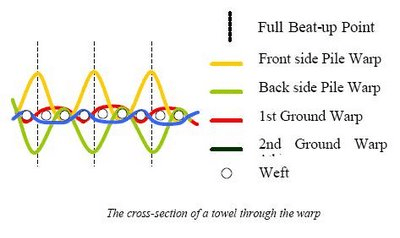
Terry towels are woven as 2, 3, 4, 5 or more pick terry weaves. The most common type is 3-pick terry toweling. The cross-section of a toweling through the Warps are divided into two systems as shown in Figure 3, pile warps and ground warps, whereas wefts consist of only one system. In basic Turkish Toweling, front side and back side pile warps and 1st and 2nd ground warp end form a 2/1 rib weave with each other.
The rib weaves which is formed by the pile warps is one pick ahead of the rib weave which is formed by ground warp ends. Warps are drafted throughout the fabric width 1:1 or 2:2 piles and ground warps. In 1:1 warp drafting order each ground warp end is followed by a pile warp end while in 2:2 warp drafting order each two ground warp ends are followed by two pile warp ends. In Figures 3a and 3b, the weave notation of 3 weft pile basic Turkish toweling is given in 1:1 and 2:2 warp orders.
As is seen from the weave diagrams in Figures a and b, the shedding of the ground warps is not synchronized with that of the pile warps. By this, the number of interlacing throughout the warp increases, and this strengthens the fabric. As it has been mentioned before terry towels can have pile loops on one or both faces. Different types of terry weave which have piled on one face and both faces.
Basic 3-pickup terry weave in 1:1 Warp Order
Basic 3-pickup terry weave in 2:2 Warp Order
G: Ground Warp FP: Front Face Pile Warp BP: Back Face Pile Warp Little block: Ground warp is over the weft Shaded: Front Face Pile Warp is raised over the weft X: Back Face Pile Warp is raised over the weft Empty space: Warp is lowered behind the weft
The picks used for toweling is between 15 and 25 picks/cm. And ends used are between 20 and 30 ends/cm. During the weaving of borders, the picks are increased 3 to 6 times the density in the pile areas Pile/ground ratio is described as the length of pile warp per unit length of fabric in the warp direction.
A practical way to find out this ratio is done by measuring a 10 cm length of toweling in the warp direction, then cut the pile warp from either end of the measured length and measure the total length of the removed pile end per 10 cm length of fabric. Pile warp length per 10 cm fabric is usually between 20-100 cm. This ratio has a direct effect on fabric weight and thickness. As the ratio increases, the weight and the thickness of the terry fabric increases.
The manufacturing process of Terry Towels
Spinning
This is the process where selected fibers are converted to yarns of desired counts needed for towels. Some integrated textile towelling mills produce their own yarns for towels. They purchase bales of cotton of a specific grade as per their working plan.
Mixing of fibers are formulated as per the required plan and are subjected to required atmospheric conditions before they are passed through the blow room line. Here strictly mill mixing plan is being followed. According to the mix plan selection of machines to process and their machine settings are made before mixing is allowed to pass through the blow room line.
Once planned results in the blow room process are accomplished then these fibers are passed directly through chute feeding to well-set carding machines and fibers are converted into slivers.
These carding slivers are tested for various technological parameters before they are passed to next process Drawing frames. These draw frames are set as per working plan and slivers are passed through for effective blending and parallelization of fibers. Draw frame slivers are tested for parameters and if passed they are further processed. Draw frame slivers may be semi-combed then again passed through draw frames before they are fed to roving frames (Speed frame).
Slivers are converted to rovings of specified hank as per spinning plan. Thereafter these roving bobbins are fed to ring frames well set with technological parameters as per spinning plan where they are converted to particular yarn counts to be used for terry towels.
These ring bobbins are fed to automatic winding machines where the yarn is converted to packages. These winding machines are also ser for different setting required as per spinning plan.
Whenever double yarns are needed for weaving terry towels the single yarns are processed on TFO machines to convert them to double yarns with defined twist factor and direction of the twist as required for towels.
Preparation of spinning plan is very critical and needs a lot of knowledge and understanding of spinning technology. Application of this spinning plan determines yarn parameters and yarn quality and hence needs close supervision from process control and quality control laboratory.
Comprehensive Weaving manufacturing plan is prepared as per terry towel set and construction.
Warping/Sizing/Drawing-in
Yarn packages are assembled on warping creel as per construction plan, required tensions are set on each yarn package and are processed on sectional or direct warping machines depending on single/double yarns are used.
All machine settings, machine speed is set as per instruction sheets of weaving plan. All warping sets made from single yarns are processed on sizing machines where a starch coating is applied on individual threads to make it weave able on weaving machines. Double yarns sets may or may not be passed through sizing machines. Single sized beams and double sized or unsized beams are taken to drawing in department and beams are drawn as per drawing in weaving plan to make them ready to load on weaving machines.
Loading of beams is high skill jobs which are to be carried out under the close supervision of weaving staff. Before machines are loaded on weaving machines, machines are to be well set, speeds adjusted as per an article by experienced, skilled and qualified weaving staff. Use of machine setting sheets as per weaving set plan is essential and important before the machine is set for production. Process control staff and weaving senior staff has to monitor the initial production of few towels and inspect on the machine and off the machine the various parameters of the towel and should exactly match as per weaving plan. Once passed the machine is allowed to go into production.
Mechanism of terry weave in terry fabric manufacturing, two sheets of warp threads run simultaneously, of which, one is kept under normal tension and other is kept under loose tension. The threads of normal tension warp sheet are for ground and threads of loose tension warp sheet are for the pile.
The sequence of operations during weaving for pile formation in 3-pick terry is given below:
Insertion of the first pick as per the design with loose beating
Allow a predetermined gap near the feel of cloth
Insertion of the second pick following the first pick with loose beating
Insertion of the third pick with heavy beating and bring all the three picks to the fell of the cloth.
Pile formation
Pile of the towel plays a major role for a towel for its water absorbency and other properties. Loop length is decided by the quality, weight, etc. as per requirements. Pile manufacturers use better quality yarn like combed, compact, hydro, zero twisted yarns.
Piles are made by different high-value fibers like superior qualities of cotton suvin, Giza, Pima, bamboo, modal etc. to get better absorbency and lint properties.
For ground yarn, comparatively coarser counts are used in OE and 2-ply option to give better strength and compactness in ground fabric.
Both piles and ground yarns are prepared in the same manner of warping, sizing, and drawing-in. Like other textile products shirting, suiting, sheeting fabrics, towel making has the same process sequences – desizing, bleaching, dyeing and finishing.
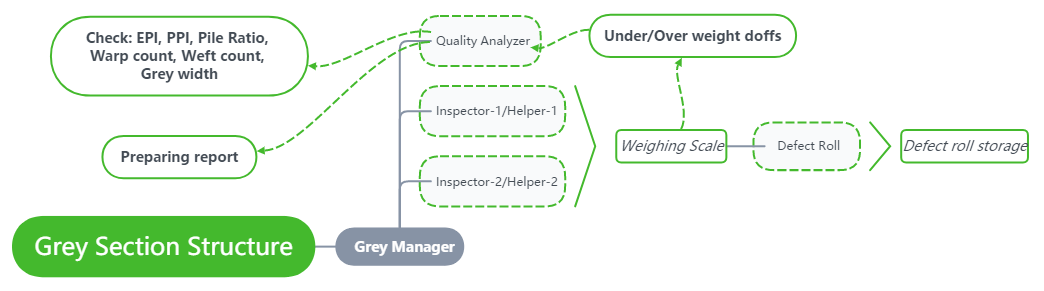
Grey inspection
Once towels are manufactured on the looms and their production is monitored through process control the towel roles are cut as per specification sheet and brought to inspection room.
From inspection room storage selected quality rolls passed for quality as per processing plan are dispatched to process house for bleaching and dying operations.
Bleaching
These selected rolls are transported by using recommended trolleys to bleaching section and are bleached in J-Box machine which is a continuous bleaching machine. The fabric is treated with bleaching recipes such as hydrogen peroxide, caustic defoamers and other ingredients.
Reaction time and machine speed have to be set as per process plan prepared after considering all activity factors. After the roll is bleached it is sent to washing machines and washed thoroughly so that no trace of chemicals remains on the fabric. Then these rolls are dried and sent to Dyehouse. All procedural requirements are followed so that the rolls can be identified at any stage during processing and in storage.
Dyeing
As per requirement order from dye house, bleached rolls are transported to dye house for dying operations for various colours as per dye house planning sheets. Dried uncut rolls are taken to Dying machines for dying with vat color using vat dye receipt. This has proven over time to provide colorfast toweling after extensive residential laundering.
It is sent to washing machines and washed thoroughly so that no trace of chemicals and lose dye particles remain on the fabric. Then these rolls are dried on an air-drying machine and sent to folding cutting/folding and packaging department. All procedural requirements are followed so that the rolls can be identified at any stage to avoid mix-ups during processing and in final storage.
Cutting, folding, and packaging
As per final inspection plan, rolls are transported with special care to finish folding department.
Instruction techniques to follow are for visual inspection
Step 1: is to open these rolls and are cut as per instruction sheets
Step 2: is to stitch / ham towels
Step3: Each towel stitched is inspected by a quality inspector attached to a respective table. He has to ensure defect free towel on both sides, the label for passing and sent to final inspection table. The rejected towels are to be kept separately for operational departmental inspection
Step 4: Final inspection by a senior inspector passed, labeled and sent for final packaging and dispatching. Rejected towels are kept separately.
Quality Control
Quality assurance department plays an important role to monitor, check, and control each manufacturing activities and operations from receiving all raw material to the final dispatch of products. This is controlled through close supervision and active participation of on-line process control and off-line quality control laboratory. Most common defects found in terry towels are…
Objectional odors, Holes (two or more broken ends), abrasion mark, Bow, Skew, crease, oil stains, dye stains, miss pick, double picks, sharp press mark, fiber contamination, dye/bleach shade variations.
All Towels manufacturing mills need to have a strong quality assurance department which is capable to coordinate with production line and assist them to provide vital quality productivity information continuously.
All incoming inputs bought for the manufacturing process are thoroughly examined for their quality parameters as laid down by production plan before they are used during manufacturing operations.
Caring for your Towels
Wash towels at between 40-60°C
Wash with similar colours or use a colour catcher
Tumble dry towels to keep them soft and fluffy
Use fabric conditioners sparingly and not in every wash as they decrease absorbency
Wash separately from garments with zips or trims to avoid snagging
Shake towels before washing –this opens up the fibres slightly to allow the detergent to sink inside.
Key points to focus during production planning
Customers support. Fully understanding customers requirements and their expectations.
Process control providing products utilizing proven designs and manufacturing process.
Top employees developing a highly trained workforce that is skilled, motivated, understandable, empowered and fully accountable.
Robust supply chain: establishing strong relationships with world-class suppliers
continuous improvement: continually improve the efficiency of the business processes and operational activities and operations, quality management systems.
Calculations for terry towels to find the weight of ground warp, pile warp and weft yarn
Assumptions
Number of Ground Warp Ends = 694
Ground Warp Count = 25 tex x 2
Warp Crimp = 8%
Weft Yarn count = 34 tex
Number of Pile Warp Ends = 576
Length of pile part = 102 cm
Pile Ratio (for pile height)= 52:10 (52 cm of pile warp for 10 cm of cloth)
Textile design is essentially the process of creating designs
for woven, knitted or printed fabrics or surface ornamented fabrics.
Textile designers are involved with the production of these designs,
which are used, sometimes repetitively, in clothing and interior decor
items.
The field encompasses the actual pattern making while supervising the production process.
In other words, textile design is a process from the raw material into
finished product. Fiber, yarn and finishes are the key elements to be
considered during the textile design procedure.
Overview
Textile designing is a creative field that includes fashion design, carpet manufacturing and any other cloth-related field.Textile design fulfills a variety of purposes in our lives. For example, our clothing, carpets, drapes, towels, and rugs are all a result of textile design.
These examples illustrate the significance of textiles in our
daily lives. The creations of textiles are not only important for their
use, but also for the role they play in the fashion industry. Textile
designers have the ability to inspire collections, trends, and styles.
The textile industry, while being a creative art form, is a very
business savvy industry.
Textile designers marry a creative vision of what a finished
textile will look like with a deep understanding of the technical
aspects of production and the properties of fiber, yarn, and dyes.
The creative process often begins with different art mediums to
map concepts for the finished product. Traditionally, drawings of woven
textile patterns were translated onto special forms of graph paper called point papers, which were used by the weavers in setting up their looms.
Today, most professional textile designers use some form of computer-aided designsoftware created expressly for this purpose.Some of the latest advances in textile printing have been in the area of digital printing. The process is similar to the computer controlled paper printers used for office applications.
In addition, heat-transfer printing is another popular printing method
to be used in the textile design.
Patterns are often designed in repeat to maintain a balanced design even
when fabric is made into yardage. Repeat size is the distance directly
across or down from any motif in a design to the next place that same
motif occurs. The size of the repeat is determined by the production
method. For example, printed repeat patterns must fit within particular
screen sizes while woven repeat patterns must fit within certain loom
sizes. There are several different types of layouts for repeated
patterns. Some of the most common repeats are straight and half drop.
Often, the same design is produced in many different colored versions,
which are called colorways.
Once a pattern is complete, the design process shifts to choosing the
proper fabrics to get the design printed on or woven into the fabric
Designers might want to use the method of dyeing or printing to create their design. There are many printing methods.
Direct (Blotch) Printing
Overprinting
Discharge Printing
Resist Printing
Block Printing
Roller Printing
Screen Printing
So,
what exactly does a textile designer do? Picture yourself working for a
company that makes special novelty socks. They want their socks to sell
better than anybody else's so they hire a textile designer (you) to make
their socks the best. Not all textile designers get to choose the
materials they work with, but this sock company has the time and money
to invest in the best product possible, so they give their textile
designers a lot of power. One of your first steps is to pick the
materials used to create these socks. Socks need to be soft, thick
enough for cushioning, lightweight enough for comfort, strong enough for
prolonged use, and absorbent. So, you choose to avoid a fragile
material like linen or a course material like hemp. Cotton is a good
option, as are synthetic fabrics like polyester.
Textile
designers that have control over this part of the process have a lot of
decisions to make. Besides just picking the fabrics, they may also need
to consider what fiber types, yarn sizes, or kinds of dyes will be used,
as well as how those dyes will be applied. Are you going to print the
design by hand or with a machine? Should the fabrics be bleached or left
natural? Are any parts of the design going to be embroidered or sewn?
There's a lot to think about.
Theory: Yarn count: The yarn count
is a numerical expression which defines its fineness or coarseness. It
also expresses weather the yarn is thick or thin. A definition is given
by the textile institute – “Count is a number which indicates the mass
per unit length or the length per unit mass of yarn.”
To determine the count of the yarn
we use five instruments with wrap reel & analytical balance.
Beesley balance is one of them. It is working on the principle of fixed
weight and fixed length system
Objectives of Experiment:
To know about yarn count.
To know about template & beesley balance.
To know how to determine the count by template & beesley balance.
Required Instrument:
Template
Beesleys Balance
Knife
Marking pen
Needle
Template: Template
is a length measuring instrument which contains eight arms. When a
sample has short length (Fabric) which we cannot determine by the wrap
reel then we use template by using that we can determine the length .
Fig: Beesley balance
The following length is used to determine the count:
Cotton : 4.32 Inch
½ cotton :2.16 Inch
Linen :1.543 Inch
Wool :1.315 Inch
Worsted :2.88 Inch
Beesleys Balance: Beesleys
yarn balance consists of a pillar A which carries a cross beam B,
fulcrumed at knife edge at the point G. At one end the cross beam is a
hook E upon which the yarn to be tested can be placed. The other end of
the beam tappers to a point C. When the beam is in balance, the pointer
will coincide with the detum line .The pillar is mounted on the base.
The whole instrument is leveled by a leveled screw at one end of the
base. The cross has a small notch at the point D to take the counter
weight or rider
Data Collection:
SampleNo
Amount of
yarn
Yarn Count
Average Count
01
29
29
30s
02
30
30
03
31
31
04
30
30
05
30
30
06
29
29
07
30
30
08
31
31
09
30
30
10
30
30
Result: The cotton sample fabric warp yarn count is 30s
Procedure:
Collect sample by appropriate sampling method.
This Sample conditioning at testing atmosphere.
Marked the fabric by using template
Cut that’s fabric by knife according to the marking.
The
pointer is set directly opposite to the detum line, with no material
and counter weight in their proper places, by adjusting the leveling
screw. The counter weight for the particular length which is supplied
with the instrument is chosen and suspended at the notch D. (For full
cotton the large rider is placed in the notch and for ½ cotton small
rider is placed)
Now yarn is withdrawn from sample and placed sample hook until the pointer comes in level with the detum line.
At that stage the threads are taken out and counted which givers directly the cont of yarn teken for testing.
There 30 threads in the sample hook at the balanced condition so the count of the yarn is 30s
Precaution:
We should yarn withdrawn from fabric very carefully.
Marked fabric very carefully.
Conclusion:
It
is the very easy process but if we cannot use template properly
according to yarn type and idle weight than the result will be faulty.
Cotton is a soft staple fibre that grown in a form known as a boll around the seeds of the cotton plant, a shrub native to tropical and subtropical regions.
Cotton
Cotton today is the most used textile fiber in the world. Its current market share is 56 percent for all fibers used for apparel and home furnishings and sold in the U.S. Another contribution is attributed to nonwoven textiles and personal care items. The earliest evidence of using cotton is from India and the date assigned to this fabric is 3000 B.C. There were also excavations of cotton fabrics of comparable age in Southern America. Cotton cultivation first spread from India to Egypt, China, and the South Pacific.
Cotton is a soft, staple fiber that grows in a form known as a boll around the seeds of the cotton plant, a shrub native to tropical and subtropical regions around the world, including the Americas, India, and Africa. The fiber most often is spun into yarn or thread and used to make a soft, breathable textile, which is the most widely used natural-fiber cloth in clothing today. The English name derives from the Arabic (al) qutn قُطْن , which began to be used circa 1400.
Each cotton fiber is composed of concentric layers. The cuticle layer on the fiber itself is separable from the fiber and consists of wax and pectin materials.
Cotton is a soft fiber that grows around the seeds of the cotton plant. Cotton fiber grows in the seed pod or boll of the cotton plant. Each fiber is a single elongated cell that is flat twisted and ribbon-like with a wide inner hollow (lumen).
90% cellulose, 6% moisture and the remainder fats and impurities.
The outer surface is covered with a protective wax-like coating which gives fiber an adhesive quality.
Cotton is a natural fiber that is grown in countries around the world. It is a crop that requires adequate moisture and heat to mature and produce quality fibers. Cotton growing tends to be in warmer climates. Cotton is a true commodity in the world markets and supply and demand truly affect prices of raw cotton.
Cotton fibers are mainly made up of cellulose. Cellulose does not form unless temperatures are over 70 °F (21 °C). The cotton fibers are attached to the seeds inside the boll of the plant. There are usually six or seven seeds in a boll and up to 20,000 fibers attached to each seed. The length of these fibers (also called staples) is the main determining factor in the quality of the cotton. In general, the longer the staple grows the higher the quality of the cotton. Staple lengths are divided into short, medium, and long (and extra long, in some cases):
Short staple cotton is between 3/8” to 15/16” (.95cm to 2.4cm) in length
Medium staple cotton is between 1” to 1-1/8” (2.54cm to 2.86cm) in length
Long staple cotton is between 1-3/16” to 2-1/2” (3cm to 6.35cm) in length
Properties of Cotton Products
Comfortable – there are no surface characteristics of cotton that make it irritating to human skin. Cotton feels good against skin; it has a soft hand.
Hydrophilic – cotton has a natural affinity for water – it attracts moisture away from your body.
Moisture passes freely through cotton – aiding in evaporation and cooling
Good Heat Conductivity – Cotton allows heat to dissipate making it a wonderful fiber to maintain a comfortable sleeping temperature.
Strong and abrasion resistance
The unfavorable attributes of cotton include its lack of resiliency (cotton tends to wrinkle) and its lack of luster (colors are usually dull).
Properties of Cotton Fiber
It has 8% moisture regain
The cellulose is arranged in a way that gives cotton unique properties of strength, durability, and absorbency
It is fresh, crisp, comfortable, absorbent, flexible, has no pilling problems and has good resistance to alkalis
It has poor wrinkle resistance, shrinkage, poor acid resistance, less abrasion resistance, susceptible to damage by moths and mildew, needs lots of maintenance and stains are difficult to remove
Its fiber length ranges from ½ inches to 2inches
It has 10%increase in strength when wet.
It has a flat twisted tube shape
Long Staple Cotton
In general, long staple cotton is needed to spin the yarns needed in the weaving of the finer down proof cotton fabrics.
Long staple cotton is considered to be finer quality because they can be spun into finer yarns and those finer yarns can be woven into softer, smoother, stronger, and more lustrous fabrics. Long staple cotton makes stronger yarns, especially in fine yarns, as there are fewer fibers in a given length of yarn and the longer fibers provide more points of contact between the fibers when they are twisted together in the spinning process.
Common areas that grow long staple cotton in the world would be Egypt, Sudan, the United States (Pima cotton grown in the west and southwest are long staple cotton), and Western China. The two most widely known long-staple cottons are Egyptian cotton and Pima cotton. Pima cotton is grown mainly in the United States, but also in Peru, Israel, and Australia.
The fibers are sent to a textile mill where carding machines turn the fibers into cotton yarn. The yarns are woven into cloth that is comfortable and easy to wash but does wrinkle easily. Cotton fabric will shrink about 3% when washed unless pre-treated to resist shrinking.
Cotton is prized for its comfort, easy care, and affordability and is ideal for clothing, bedding, towels, and furnishings.
Harvesting
Cotton was once harvested by hand, often by slave labor or tenant farmers. As recently as 1965, over a fourth of the U.S. cotton crop was picked by hand. Today, harvesting cotton is highly mechanized.
Harvesting machines called strippers and pickers efficiently remove the cotton while leaving the plants undisturbed. Spindle harvester, also called a picker, has drums with spindles that pull the cotton from the boll in one or two rows at a time. Even a one-row mechanical picker can do the work formerly done by 40 hand pickers.
In stripper harvesting, the stripper moves along rows of plants, passing them between revolving rollers or brushes that pull off the cotton. Strippers also pull twigs and leaves with the cotton.
Cotton gins separate the fibers, called lint, from the seeds. After ginning, the cotton goes to the bale press that packs it into 480-pound bales about the size of a large refrigerator.
Classing Cotton
Cotton buyers judge cotton on the basis of samples cut from the bales. Skilled cotton classers grade or “class” the cotton according to standards established by the US Department of Agriculture such as cleanliness, the degree of whiteness, length of the fiber, and fiber strength.
The classes pull a sample. They discard most of the cotton until just a pinch of well-aligned fibers remains. They measure the length of the fibers, referred to as staple fibers. Longer staple fibers are higher-grade cotton and are sold at higher prices. Long staples range from 1.1 inches to 1.4 inches long.
Cotton Ginning
From the field, seed cotton moves to nearby gins for separation of lint and seed. The cotton first goes through dryers to reduce moisture content and then through cleaning equipment to remove foreign matter. These operations facilitate processing and improve fiber quality. The cotton is then air conveyed to gin stands where revolving circular saws pull the lint through closely spaced ribs that prevent the seed from passing through. The lint is removed from the saw teeth by air blasts or rotating brushes and then compressed into bales weighing approximately 500 pounds. Cotton is then moved to a warehouse for storage until it is shipped to a textile mill for use.
A typical gin will process about 12 bales per hour, while some of today’s more modern gins may process as many as 60 bales an hour.
Cotton is the world's most important natural fibre. In the year 2007, the global yield was 25 million tons from 35 million hectares cultivated in more than 50 countries.There are five stages






 Cotton is a soft fiber that grows around the seeds of the cotton plant. Cotton fiber grows in the seed pod or boll of the cotton plant. Each fiber is a single elongated cell that is flat twisted and ribbon-like with a wide inner hollow (lumen).
 Cotton was once harvested by hand, often by slave labor or tenant farmers. As recently as 1965, over a fourth of the U.S. cotton crop was picked by hand. Today, harvesting cotton is highly mechanized.
 From the field, seed cotton moves to nearby gins for separation of lint and seed. The cotton first goes through dryers to reduce moisture content and then through cleaning equipment to remove foreign matter. These operations facilitate processing and improve fiber quality. The cotton is then air conveyed to gin stands where revolving circular saws pull the lint through closely spaced ribs that prevent the seed from passing through. The lint is removed from the saw teeth by air blasts or rotating brushes and then compressed into bales weighing approximately 500 pounds. Cotton is then moved to a warehouse for storage until it is shipped to a textile mill for use.


